



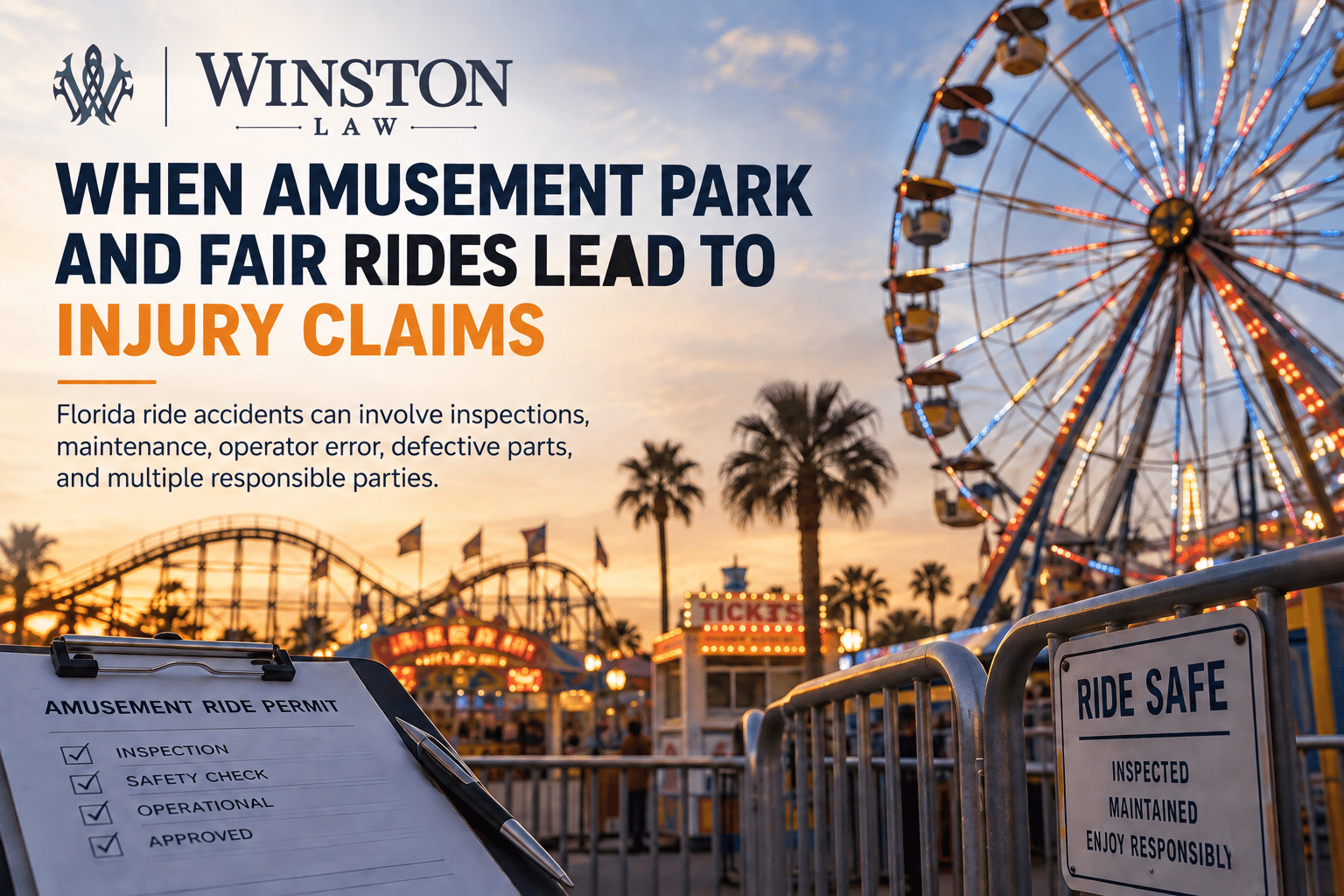
Amusement parks, county fairs, carnivals, festivals, and other attractions are supposed to provide entertainment. When a ride malfunctions, a restraint fails, an operator makes a mistake, or a dangerous condition causes an injury, the legal questions can become complicated very quickly.
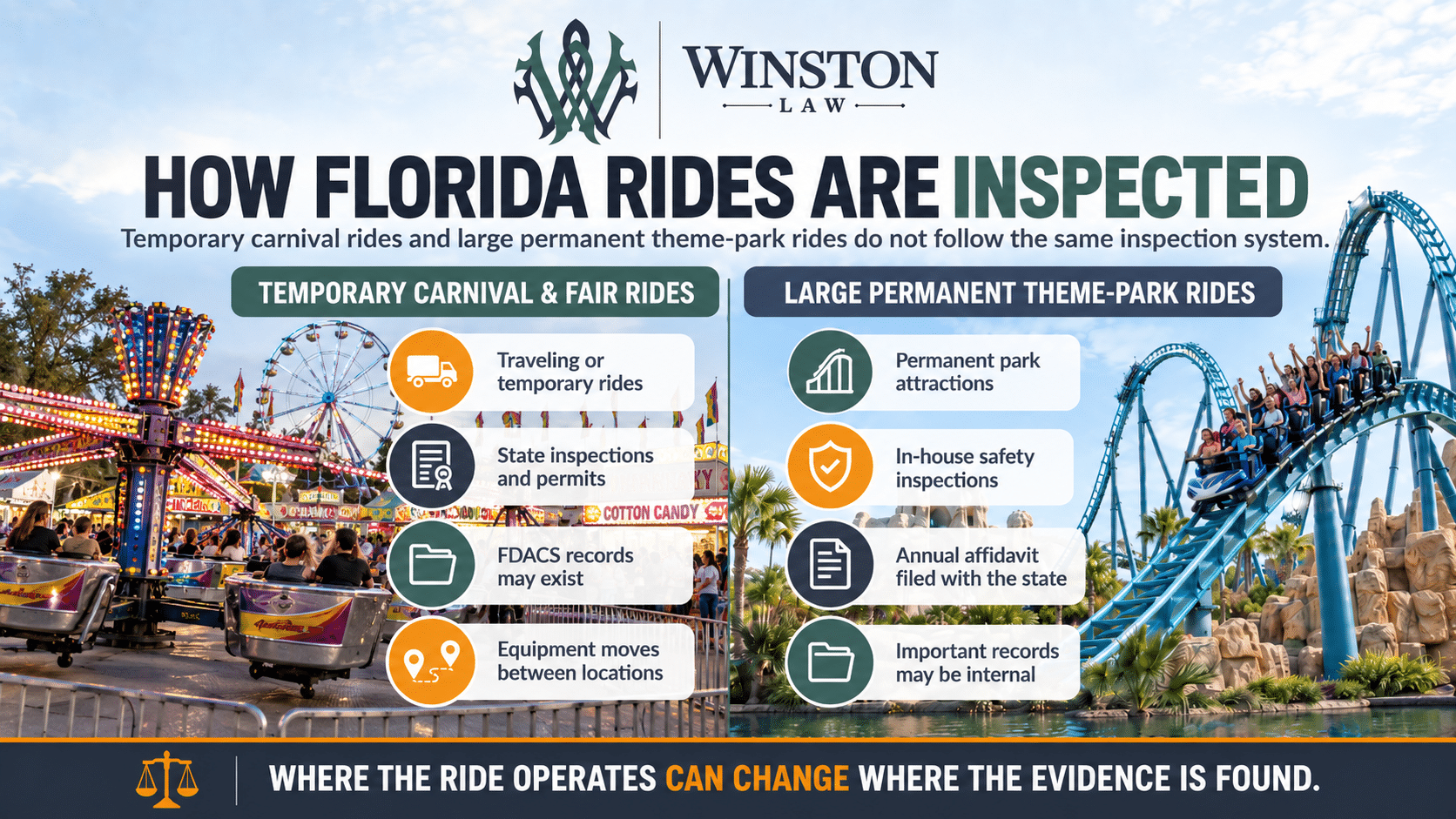
Florida regulates many amusement rides through a detailed permitting and inspection system. The rules may differ depending on whether the ride is a temporary carnival attraction, a permanent ride, or part of a large theme park that qualifies for an inspection exemption.
Those differences matter after an accident because they can affect what inspection records exist, who possesses them, what maintenance information may be available, and which companies may potentially be responsible.
A Fort Lauderdale personal injury lawyer at Winston Law can investigate how a ride accident happened, identify the parties responsible for operating and maintaining the attraction, and work to preserve evidence before it is lost or altered.
Who Inspects Amusement Park and Fair Rides in Florida?
The Florida Department of Agriculture and Consumer Services regulates many amusement rides statewide under Florida Statute §616.242.
Florida generally divides regulated rides into two broad categories:
- Permanent amusement rides that remain at a fixed facility.
- Temporary amusement rides that are regularly moved from one fair, carnival, festival, or event location to another.
Permanent rides generally require an annual permit. Florida law also provides for another state inspection about six months after the annual permit is issued, although certain inspection requirements may be affected by statutory exceptions or qualifying industry inspections.
Temporary amusement rides generally require a permit each time they are relocated or set up at a new location. That can make the inspection and permitting history particularly important when an injury occurs at a traveling carnival or temporary fair.
Why the Ride Permit May Matter After an Accident
A permit does not necessarily prove that a ride was safe at the exact moment an accident occurred. Conditions can change after an inspection.
However, permit and inspection records may help answer important questions such as:
- When was the ride last inspected?
- Did it pass the inspection?
- Were any defects or safety concerns identified?
- Were required repairs completed?
- Was the ride modified after the inspection?
- Was the ride operating under a current permit?
Florida law generally requires the permit for a regulated temporary amusement ride to be displayed in an accessible location on the ride.
After an injury, photographs of the ride, permit, warning signs, restraint system, operator station, and surrounding area may become useful evidence.
Large Florida Theme Parks May Follow a Different Inspection System
One of the most important distinctions in Florida amusement-ride law involves large permanent theme parks.
Florida exempts certain permanent facilities from the ordinary state inspection requirements when the facility employs at least 1,000 full-time employees and maintains full-time in-house safety inspectors.
Those facilities must still file an affidavit about the annual inspection, but they may handle day-to-day inspections and safety documentation internally rather than keeping them in the same state records available for a traveling carnival or smaller permanent attraction.
This distinction can affect how investigators obtain evidence after an accident.
At a county fair or traveling carnival, state inspection and permit records may provide an early source of information. At a qualifying large theme park, important records may instead include internal inspection reports, maintenance logs, employee records, repair documentation, incident reports, and electronic ride data controlled by the operator.
When Must a Florida Ride Operator Report an Accident?
Florida law imposes specific reporting requirements for certain amusement-ride accidents.
Under Florida Statute §616.242, an accident generally must be reported to the state when the owner or manager knows, or through reasonable diligence should know, about the accident and the injured patron seeks treatment at a hospital or urgent care center.
The owner or manager must generally report the incident by telephone within four hours and follow with a written report within 24 hours.
That reporting threshold is important.
An injury treated only at an on-site first-aid station, or later by another type of healthcare provider, may not trigger the same statutory reporting requirement. That does not mean the injury did not happen or that a claim cannot exist. It simply means this statute may not create a state accident report.
A State Accident Report Is Only One Piece of the Evidence
Even when an official report exists, an amusement-ride injury claim may depend heavily on other evidence.
That evidence may include:
- Surveillance or security video
- Cellphone video from other guests
- Photographs of the ride and restraint system
- Witness statements
- Operator training records
- Daily inspection checklists
- Maintenance and repair logs
- Prior malfunction reports
- Manufacturer instructions
- Electronic ride-control data
- Incident reports
- Medical records
As we discussed in our article on evidence in Fort Lauderdale personal injury claims, some of the most useful evidence may exist only briefly.
Who Can Be Liable for an Amusement Park or Fair Ride Injury?
Identifying the responsible party isn’t always as simple as naming the fair or theme park.
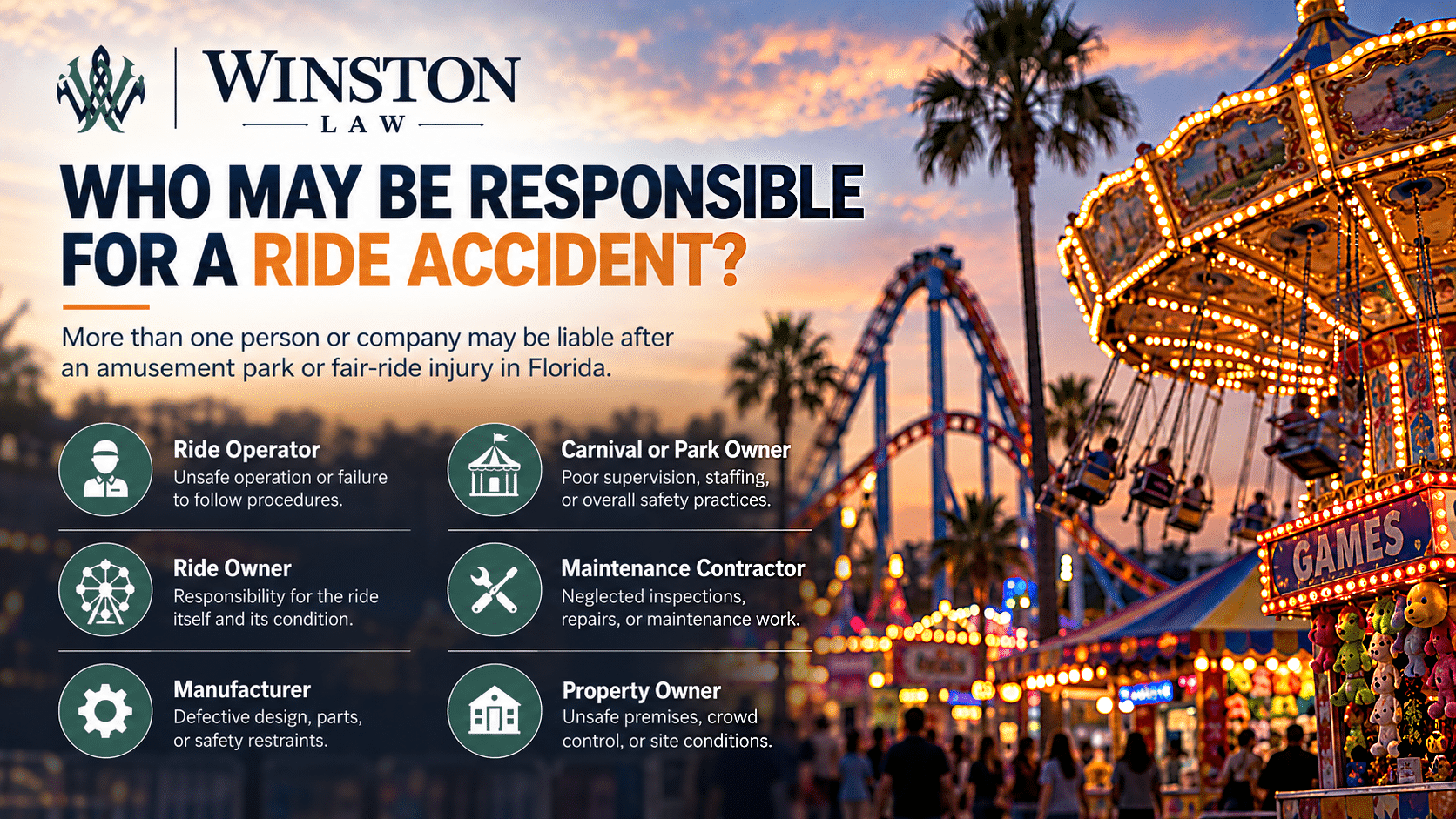
A single amusement ride may involve several separate companies or individuals.
Potentially responsible parties may include:
- The owner of the fairground or amusement facility
- The company operating the carnival or midway
- The owner of the individual ride
- The ride operator or attendant
- A company responsible for assembling or transporting the ride
- A maintenance or repair contractor
- The manufacturer of the ride or a defective component
- Another contractor responsible for the surrounding property
Which parties may be legally responsible depends on what caused the accident and each party’s duties.
Operator Error Can Lead to a Ride Injury Claim
Not every amusement-ride accident is caused by a mechanical failure.
Operator conduct may become important when an attendant or operator:
- Fails to check a restraint properly
- Allows a rider who does not meet safety requirements to board
- Ignores a visible mechanical problem
- Starts a ride before riders are properly secured
- Fails to follow required operating procedures
- Allows too many riders into a vehicle or compartment
- Fails to respond appropriately to a malfunction
Training materials, operating manuals, employee records, surveillance footage, and witness statements may help determine whether staff followed established safety procedures.
Mechanical Failures and Poor Maintenance Can Also Cause Serious Injuries
Amusement rides contain mechanical, structural, electrical, and electronic components that must function together correctly.
Potential problems may involve:
- Restraints or lap bars
- Harnesses and locking mechanisms
- Braking systems
- Bolts, welds, cables, or structural components
- Hydraulic systems
- Electrical controls
- Sensors
- Ride vehicles
- Tracks
- Emergency-stop systems
Florida’s amusement-ride law requires regulated rides to satisfy safety standards involving mechanical, structural, electrical, control, braking, and safety components.
When maintenance is an issue, repair histories and inspection records can become especially important.
Defective Ride Parts May Create a Product Liability Claim
Some accidents involve more than negligent operation or maintenance.
If a ride or one of its components was defectively designed or manufactured, you may also need to investigate a product liability claim.
Examples could include a defective restraint, structural component, control system, cable, sensor, or other part that contributed to the accident or increased the severity of the injuries.
A product-liability case may involve the manufacturer, distributor, designer, installer, or other entities in the product’s distribution chain, depending on the facts.
These claims require evidence showing the alleged defect and how it caused or contributed to the injury. That is why preserving the actual ride component, photographs, maintenance records, repair records, and engineering information can be important.
Unsafe Conditions Around the Ride Can Create a Separate Premises Liability Issue
Sometimes the injury is not caused by the ride itself.
A guest may be injured because of a dangerous condition in the loading area, queue, walkway, platform, or surrounding grounds.
Examples may include:
- Wet or slippery surfaces
- Broken stairs or railings
- Unsafe loading platforms
- Poor lighting
- Unmarked changes in elevation
- Loose cords or equipment
- Unsafe crowd-control barriers
- Debris or other walking hazards
Those claims may involve traditional premises-liability principles rather than a mechanical defect in the ride.
A Broward County premises liability lawyer may investigate who owned, operated, controlled, inspected, or maintained the area where the injury occurred.
What Happens When Several Companies Share Responsibility?
Ride-accident claims can become complicated because responsibility may be divided among several parties.
For example, a carnival company may own the ride, another company may provide maintenance, an employee may operate it, and a manufacturer may have produced the component that failed.
An investigation may need to determine:
- Who owned the ride?
- Who controlled its operation?
- Who assembled it at the location?
- Who performed the most recent inspection?
- Who maintained or repaired it?
- Who trained and supervised the operator?
- Whether a defective component contributed to the accident
- Whether prior problems had been reported
Insurance coverage may also differ from one responsible party to another.
Florida’s Comparative Fault Rule Can Affect Ride Injury Claims
Florida follows a modified comparative-fault system for many negligence claims.
If an injured person is assigned part of the responsibility for the accident, the amount of damages may generally be reduced according to that person’s percentage of fault.
Under Florida Statute §768.81, a party who is found more than 50% responsible for his or her own harm in a covered negligence action generally cannot recover damages.
In amusement-ride cases, defendants may argue that a rider:
- Ignored posted warnings
- Failed to follow operator instructions
- Attempted to stand during the ride
- Reached outside the ride vehicle
- Interfered with a restraint
- Failed to disclose a medical condition addressed by a warning
The existence of such an allegation does not automatically establish fault. Video, witness accounts, warning signs, operator instructions, and other evidence may determine what actually occurred.
What Types of Injuries Can Result From Ride Accidents?
Amusement-ride accidents can cause injuries ranging from temporary strains to severe or permanent trauma.
Depending on the force and circumstances involved, injuries may include:
- Head and traumatic brain injuries
- Neck and back injuries
- Spinal cord injuries
- Broken bones
- Shoulder injuries
- Facial injuries
- Lacerations and scarring
- Internal injuries
- Crush injuries
- Psychological trauma associated with a serious accident
Winston Law represents clients with serious injuries, including traumatic brain injuries and spinal injuries resulting from preventable accidents.
What Evidence Should You Preserve After a Ride Accident?
If circumstances allow, several steps may help preserve information that becomes important later.
- Photograph the ride from several angles.
- Photograph the restraint, seat, loading platform, and warning signs.
- Save tickets, wristbands, receipts, and reservation records.
- Get witnesses’ names and contact information.
- Identify anyone who recorded the incident on a phone.
- Save your own photographs and videos in their original form.
- Write down the ride name and carnival or operator name.
- Photograph any displayed permit or identifying information.
- Seek appropriate medical care and keep treatment records.
- Keep clothing or personal property damaged in the accident.
- Document communications with the park, fair, carnival, or insurer.
You may also want to request preservation of surveillance footage, inspection records, maintenance logs, incident reports, electronic ride data, and the ride or component itself.
Why Ride Accident Evidence Can Disappear Quickly
Evidence preservation is particularly important when a temporary carnival ride is involved.
A ride operating in Broward County today may be dismantled and moved to another part of Florida shortly afterward.
Repairs may be performed. Components may be replaced. Surveillance systems may overwrite footage. Employees and witnesses may become difficult to locate.
Once important evidence disappears, determining exactly how the accident occurred can become much harder.
How Long Do You Have to File a Florida Amusement Ride Injury Claim?
Florida currently provides a two-year limitations period for many negligence actions under Florida Statute §95.11.
However, the exact deadline can depend on the type of claim, when the cause of action accrued, the defendant’s identity, and other circumstances.
For that reason, an injured person should not assume every ride-accident claim has exactly the same deadline.
The legal filing deadline is also different from the practical evidence deadline. Surveillance footage or physical evidence may disappear long before the statute of limitations expires.
What Compensation May Be Available After a Ride Injury?
Available damages depend on the facts and severity of the injury, but a personal injury claim may include compensation for losses such as:
- Past and future medical expenses
- Lost income
- Reduced future earning capacity
- Pain and suffering
- Physical impairment
- Scarring or disfigurement
- Other accident-related economic and noneconomic losses recognized under Florida law
Serious or fatal accidents may involve additional legal issues, including potential wrongful death claims.
Frequently Asked Questions About Florida Amusement Ride Injury Claims
Who inspects amusement rides at Florida fairs and carnivals?
The Florida Department of Agriculture and Consumer Services regulates and inspects many amusement rides in Florida. Temporary rides are generally permitted when they are moved or set up at a new location, while permanent rides generally operate under annual permits and additional inspection requirements.
Does Florida inspect rides at large theme parks?
Certain large permanent facilities are exempt from the ordinary state inspection requirements when they employ at least 1,000 full-time employees and maintain full-time in-house safety inspectors. Those facilities must still file an annual inspection affidavit with the state.
Does an amusement park have to report every ride injury?
No. Florida’s statutory reporting requirement generally applies when the owner or manager knows or should know about an accident and the patron seeks treatment at a hospital or urgent care center. Other injuries may not create the same state reporting obligation.
Can more than one company be liable for a carnival ride accident?
Yes. Depending on the facts, potentially responsible parties may include the ride owner, carnival operator, individual operator, maintenance contractor, property owner, manufacturer, or another company involved in assembling, repairing, or controlling the ride.
Can I have a claim if a defective ride part caused the accident?
Potentially. If a defective restraint, control, structural component, or other part caused or contributed to the injury, you may need to investigate a product-liability claim in addition to claims involving negligent operation or maintenance.
How long do I have to file an amusement ride injury lawsuit in Florida?
Florida currently provides a two-year limitations period for many negligence actions, but the precise deadline can depend on the type of claim and circumstances involved. Evidence may disappear much sooner, so don’t treat the filing deadline as a reason to delay investigation.
Protect the Evidence After a Florida Amusement Ride Accident
Amusement-ride cases can involve an unusual combination of state safety regulations, private inspection systems, maintenance records, product defects, premises liability, multiple companies, and evidence that can disappear quickly.
For an injured rider, the most important early question may not simply be who owns the park. It may be who owned the ride, who operated it, who inspected it, who repaired it, and what evidence exists showing what went wrong.
Winston Law represents injured people in Fort Lauderdale, Broward County, and throughout Florida in personal injury cases involving unsafe property conditions, dangerous products, serious injuries, and wrongful death.
If you or a family member was injured on an amusement park, carnival, or fair ride, contact Winston Law to schedule a free consultation.