



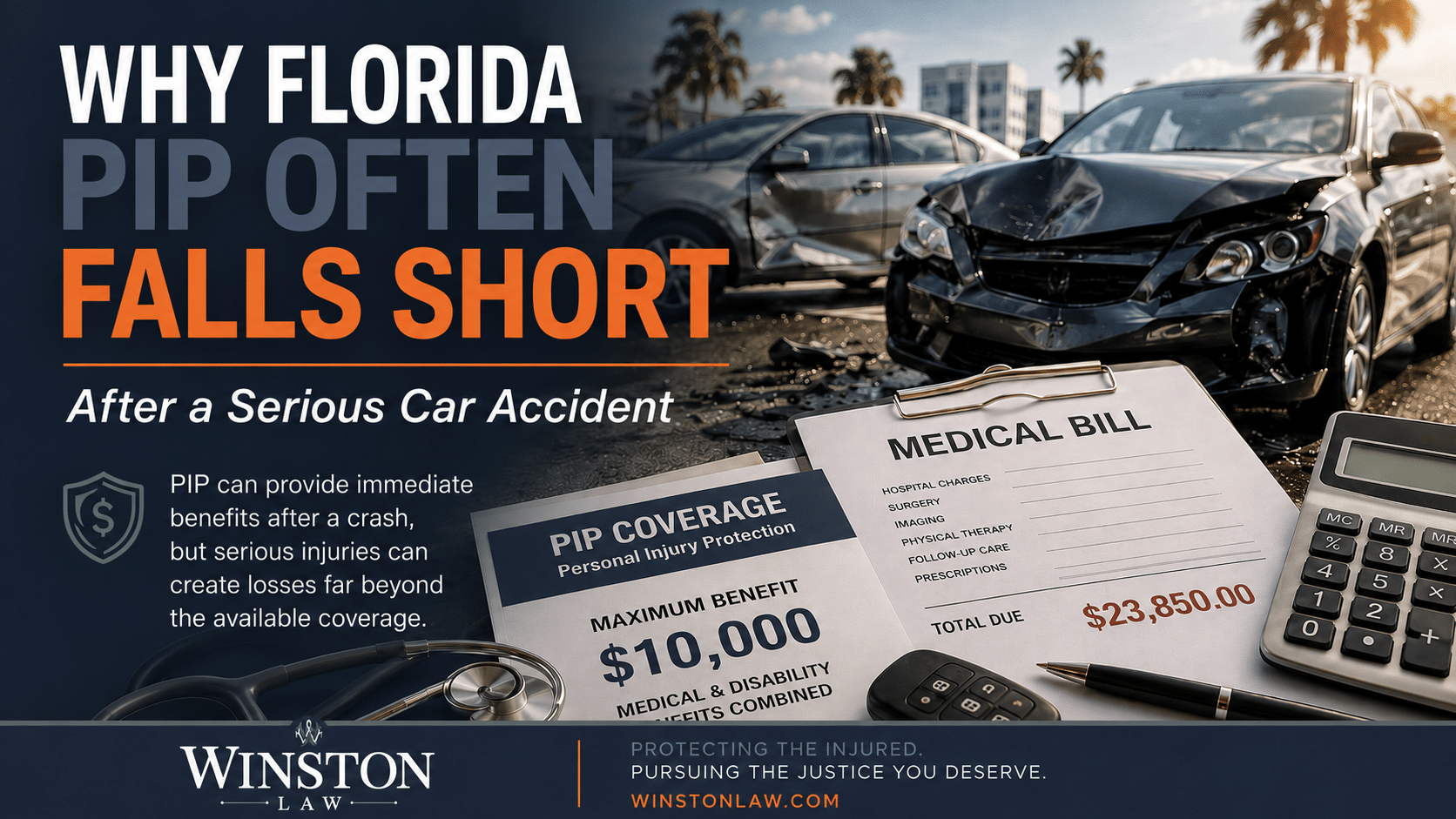
Florida Personal Injury Protection insurance can provide important benefits immediately after a car accident, but those benefits may fall far short of the losses caused by a serious crash.
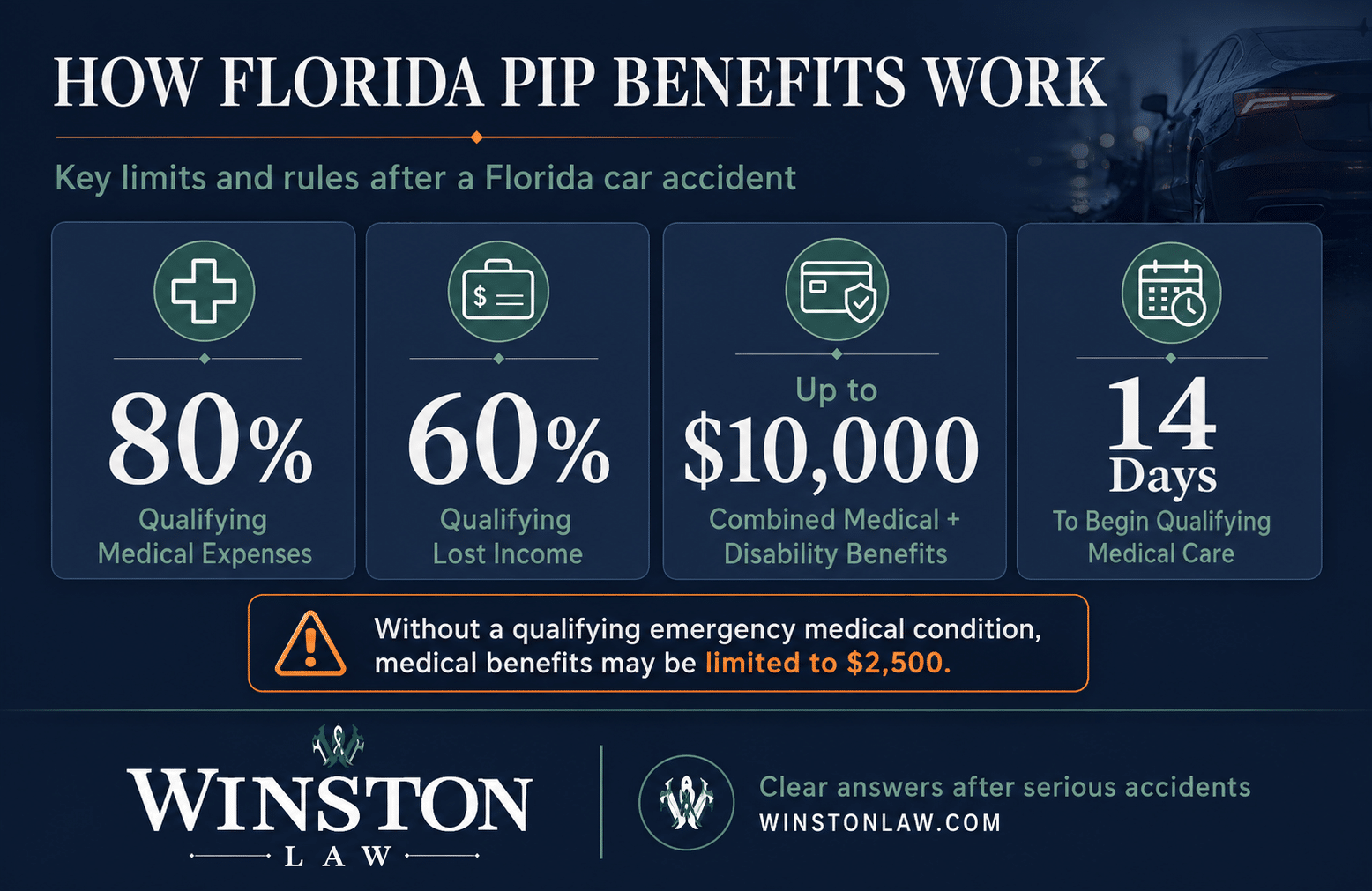
Florida PIP generally pays 80% of qualifying medical expenses and 60% of qualifying lost income, subject to a combined $10,000 limit for medical and disability benefits. That means a hospital visit, diagnostic imaging, follow-up treatment, and even a few weeks away from work can consume a substantial portion of the available coverage.
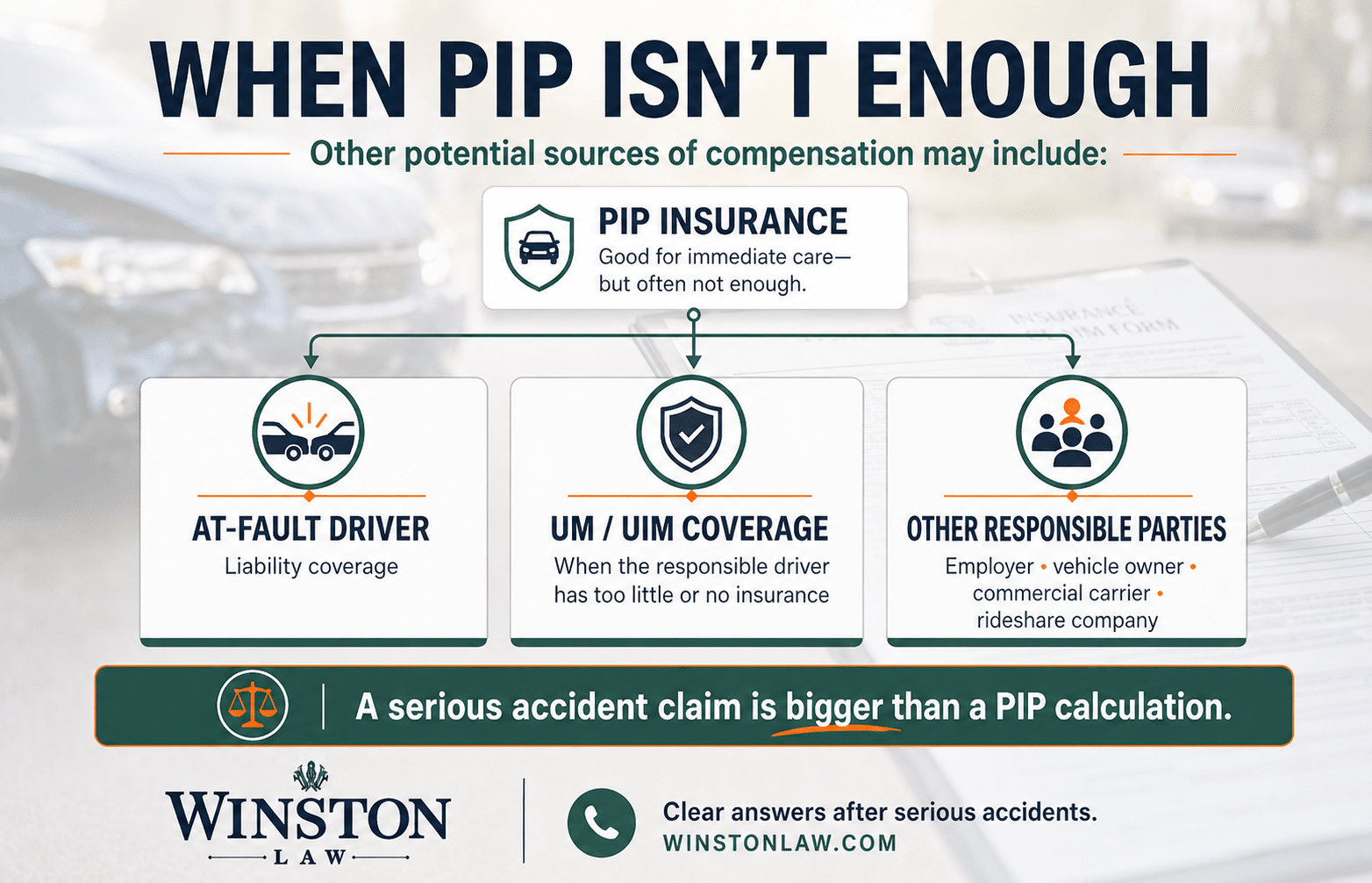
And PIP is only part of the picture. When injuries are serious, a crash victim may need to look beyond PIP to the at-fault driver’s liability coverage, uninsured or underinsured motorist coverage, or other potential sources of compensation.
A Fort Lauderdale car accident lawyer at Winston Law can review the crash, available insurance policies, medical evidence, and the full extent of the losses to determine what compensation may be available beyond PIP.
What Does Florida PIP Insurance Actually Pay After a Crash?
Florida remains a no-fault auto insurance state. Personal Injury Protection, commonly called PIP, provides certain benefits regardless of which driver caused the accident.
Under Florida Statute § 627.736, PIP provides:
- 80% of qualifying medical expenses for medically necessary treatment, subject to statutory requirements and limits
- 60% of qualifying lost gross income and earning capacity caused by the injuries
- Up to $10,000 in combined medical and disability benefits
- A $5,000 death benefit in addition to the medical and disability benefits
That structure explains why PIP may be helpful without being enough to fully compensate someone who has suffered significant injuries.
Why the $10,000 PIP Limit Can Run Out Quickly
The $10,000 limit is not $10,000 for medical treatment plus another $10,000 for lost wages. Medical and disability benefits generally draw from the same $10,000 maximum.
Suppose an injured person requires emergency treatment, imaging, specialist visits, and physical therapy while also missing several weeks of work. Medical expenses and wage-loss benefits can reduce the available PIP coverage at the same time.
PIP also does not generally pay 100% of covered medical expenses. The statutory medical benefit is typically 80%, meaning the remaining portion may have to be addressed through health insurance, other available coverage, a claim against the responsible party, or other means depending on the circumstances.
For someone with a serious injury requiring surgery, hospitalization, prolonged rehabilitation, or months away from work, a $10,000 PIP limit may represent only a small portion of the actual losses caused by the crash.
The Florida PIP 14-Day Treatment Rule
One of the most important PIP requirements involves the timing of medical care.
Florida law generally requires an injured person to receive initial services and care within 14 days after the motor vehicle accident for PIP medical benefits to apply.
This is one reason it is important not to ignore symptoms after a crash. Some injuries involving the neck, back, head, soft tissues, or other areas may not seem severe immediately after the collision. Adrenaline and shock can also mask symptoms during the hours following an accident.
Prompt medical evaluation serves two purposes: it allows healthcare professionals to identify injuries that may require treatment, and it creates medical documentation showing when symptoms and treatment began after the crash.
Why Some Florida PIP Claims Are Limited to $2,500
Even with $10,000 in PIP coverage, you may not be able to use the full amount for medical treatment.
Florida law allows reimbursement of up to $10,000 for qualifying medical services when an authorized medical provider determines that the injured person had an emergency medical condition.
If a qualifying provider determines that the injured person did not have an emergency medical condition, reimbursement for medical services can be limited to $2,500.
This makes medical documentation particularly important after a crash. The severity of the injury, the provider’s findings, the timing of treatment, and the applicable statutory requirements can directly affect the PIP benefits available.
PIP Does Not Fully Compensate You for Every Car Accident Loss
PIP limitations go beyond the $10,000 cap.
A serious accident can create losses that PIP was never designed to fully address, including:
- Medical expenses beyond available PIP benefits
- Future medical treatment
- Lost income not fully replaced by PIP
- Reduced future earning capacity
- Permanent impairment or disability
- Pain and suffering when Florida’s legal threshold is satisfied
- Emotional distress
- Loss of enjoyment of life
- Other damages supported by the facts of the case
This is why understanding PIP is only the beginning of evaluating a serious Florida car accident claim.
When Can You Pursue Compensation Beyond Florida PIP?
Florida’s no-fault system limits when a person injured in a motor vehicle accident can recover damages for pain, suffering, mental anguish, and inconvenience.
Under Florida Statute § 627.737, the injury must generally involve at least one of the following:
- A significant and permanent loss of an important bodily function
- A permanent injury within a reasonable degree of medical probability, other than scarring or disfigurement
- Significant and permanent scarring or disfigurement
- Death
Meeting this threshold can allow an injured person to seek qualifying non-economic damages from an at-fault party.
The medical evidence matters. Treating physician opinions, diagnostic imaging, treatment records, specialist evaluations, and evidence documenting the injury’s long-term effects can all become important when the seriousness or permanence of an injury is disputed.
Where Can Additional Compensation Come From After PIP Runs Out?
Once PIP benefits are exhausted or clearly insufficient, an attorney can investigate other sources of potential recovery.
The At-Fault Driver’s Liability Insurance
If another driver’s negligence caused the accident and applicable liability coverage is available, a claim may be pursued against the responsible driver and insurer for damages supported by the case.
Unlike PIP, a liability claim requires evidence establishing another party’s responsibility for the crash.
Uninsured and Underinsured Motorist Coverage
Not every driver carries enough liability insurance to compensate someone who suffers a serious injury. Some drivers carry no applicable bodily injury liability coverage at all.
If you purchased uninsured or underinsured motorist coverage, that coverage may provide an additional source of compensation when the responsible driver has insufficient insurance. Our Fort Lauderdale uninsured motorist accident lawyers can review your policy and the coverage available after the crash.
Additional Responsible Parties
Some crashes involve more than one potentially responsible party. Depending on the facts, liability may extend beyond the individual driver to an employer, vehicle owner, commercial carrier, rideshare company, or another person or business.
For example, accidents involving Uber or Lyft can involve additional insurance questions. Winston Law’s Fort Lauderdale rideshare accident lawyers can evaluate what coverage may apply based on the driver’s status and the circumstances of the collision.
What Happens in a Hit-and-Run or Uninsured Driver Accident?
PIP may still provide qualifying medical and disability benefits after certain hit-and-run or uninsured-driver accidents because PIP benefits generally do not depend on proving the other driver was at fault.
But PIP alone may not cover the full losses caused by a serious injury.
Additional recovery in a hit-and-run or uninsured-driver case can depend heavily on the insurance policies involved, including whether uninsured motorist coverage is available. Police reports, witness accounts, surveillance footage, vehicle damage, and other evidence may also help identify a hit-and-run driver or establish how the crash occurred.
Winston Law has additional information about uninsured motorist coverage in Florida and why that coverage can be important after a serious accident.
How Florida’s Comparative Fault Rule Can Affect Your Recovery
Florida’s modified comparative fault law can also affect compensation after a car accident.
Under Florida Statute § 768.81, damages in a negligence case may be reduced according to the injured person’s percentage of responsibility.
A person found to be more than 50% at fault for their own harm generally cannot recover damages in a negligence action covered by the statute.
For example, an insurance company may argue that the injured driver was speeding, distracted, following too closely, or otherwise contributed to the collision. Evidence such as crash-scene photographs, witness statements, surveillance footage, vehicle damage, electronic data, and accident reconstruction may be used to determine how responsibility should actually be allocated.
How Long Do You Have to File a Florida Car Accident Lawsuit?
Florida generally provides a two-year statute of limitations for negligence actions under Florida Statute § 95.11.
However, the applicable deadline can depend on when the accident occurred and the specific type of claim involved. Florida changed the general negligence limitations period in 2023, so older accidents may require different analysis.
Waiting can also create problems long before the filing deadline expires. Surveillance footage can be overwritten, vehicles may be repaired or destroyed, witnesses can become harder to locate, and electronic evidence may not be preserved indefinitely.
Speaking with an attorney early gives you more time to investigate the collision, preserve evidence, review applicable insurance coverage, and determine the deadline that applies to your specific case.
Why a Serious Car Accident Claim Requires More Than a PIP Calculation
A serious injury claim should not be evaluated simply by asking how much PIP money remains.
The larger questions include:
- Who caused the crash?
- How serious and permanent are the injuries?
- What medical treatment will be needed in the future?
- How much income has already been lost?
- Will the injuries reduce future earning capacity?
- What liability insurance is available?
- Is uninsured or underinsured motorist coverage available?
- Are there additional parties who may be legally responsible?
- Does the injury satisfy Florida’s threshold for non-economic damages?
Those questions can make the difference between viewing a case as a $10,000 insurance claim and understanding the actual financial and personal consequences of a serious collision.
Frequently Asked Questions About Florida PIP Insurance
How Much Does Florida PIP Insurance Pay After a Car Accident?
Florida PIP generally pays 80% of qualifying medical expenses and 60% of qualifying lost income, subject to a combined limit of up to $10,000 in medical and disability benefits. Florida law also provides a $5,000 death benefit in addition to the medical and disability benefits.
The amount actually available for medical treatment can be lower in some situations. For example, medical reimbursement may be limited to $2,500 when a qualifying medical provider determines that the injured person did not have an emergency medical condition.
What Happens When My PIP Benefits Run Out?
When PIP benefits are exhausted, that does not necessarily mean your ability to recover compensation is over. Depending on how the accident happened and the insurance coverage available, additional compensation may be pursued from the at-fault driver, applicable bodily injury liability coverage, uninsured or underinsured motorist coverage, or another responsible party.
A serious accident should therefore be evaluated based on the entire claim, not simply the amount of PIP benefits remaining.
Do I Have to Get Medical Treatment Within 14 Days After a Florida Car Accident?
Florida law generally requires an injured person to receive initial medical services and care within 14 days after a motor vehicle accident to qualify for PIP medical benefits.
Prompt medical evaluation can also help identify injuries that may not be immediately obvious and create documentation connecting the symptoms and treatment to the accident.
Can I Sue the At-Fault Driver After PIP Pays My Medical Bills?
Potentially. PIP does not prevent every claim against an at-fault driver. An injured person may be able to pursue additional economic damages beyond available PIP benefits when another party caused the crash.
Florida law places additional restrictions on recovering damages for pain, suffering, mental anguish, and inconvenience. Those damages generally require an injury that meets Florida’s statutory threshold, such as a permanent injury, significant and permanent loss of an important bodily function, significant and permanent scarring or disfigurement, or death.
Does Florida PIP Cover Pain and Suffering After a Car Accident?
No. PIP is primarily designed to provide qualifying medical, disability, and death benefits. It does not compensate an injured person for pain and suffering.
Recovering pain-and-suffering damages generally requires pursuing a claim against an at-fault party and satisfying Florida’s statutory injury threshold. Whether that threshold is met depends on the medical evidence and the circumstances of the injury.
Find Out What Your Fort Lauderdale Car Accident Claim May Be Worth Beyond PIP
Florida PIP provides a starting point after many car accidents, but it was not designed to fully compensate every person who suffers a serious injury.
If your medical bills are increasing, you have missed work, your injuries may have long-term consequences, or you are unsure what insurance coverage is available, Winston Law can review the complete picture.
Our attorneys represent people injured in car accidents and other motor vehicle crashes throughout Fort Lauderdale and Broward County. We can review your medical records, investigate how the accident happened, identify available insurance coverage, document your losses, and determine whether additional compensation may be available beyond PIP.
If you were seriously injured in a crash, contact Winston Law to schedule a free consultation.