



 Boating is part of everyday life in South Florida, from weekend trips on the Intracoastal Waterway to fishing, cruising, jet skiing, and offshore outings along the Atlantic coast. But when a boat or watercraft accident causes serious injury, the legal issues can quickly become complicated.
Unlike a typical car accident, a boating accident may involve state boating laws, federal maritime rules, navigation standards, insurance coverage disputes, rental agreements, vessel maintenance issues, and multiple people or companies sharing responsibility. Liability often depends on who controlled the vessel, whether the operator followed safe boating practices, whether alcohol or reckless conduct played a role, and whether a boat owner, rental company, manufacturer, or another party contributed to the accident.
Winston Law represents injured people in Fort Lauderdale, Broward County, and surrounding South Florida communities. If you were hurt in a boat, jet ski, charter, marina, dock, or other watercraft-related accident, understanding how liability works is an important first step toward protecting your claim.
What Determines Liability in a Boat Accident in Fort Lauderdale, FL?
Liability in a Fort Lauderdale boat or watercraft accident usually turns on whether someone failed to exercise reasonable care under the circumstances and whether that failure caused or contributed to the injury.
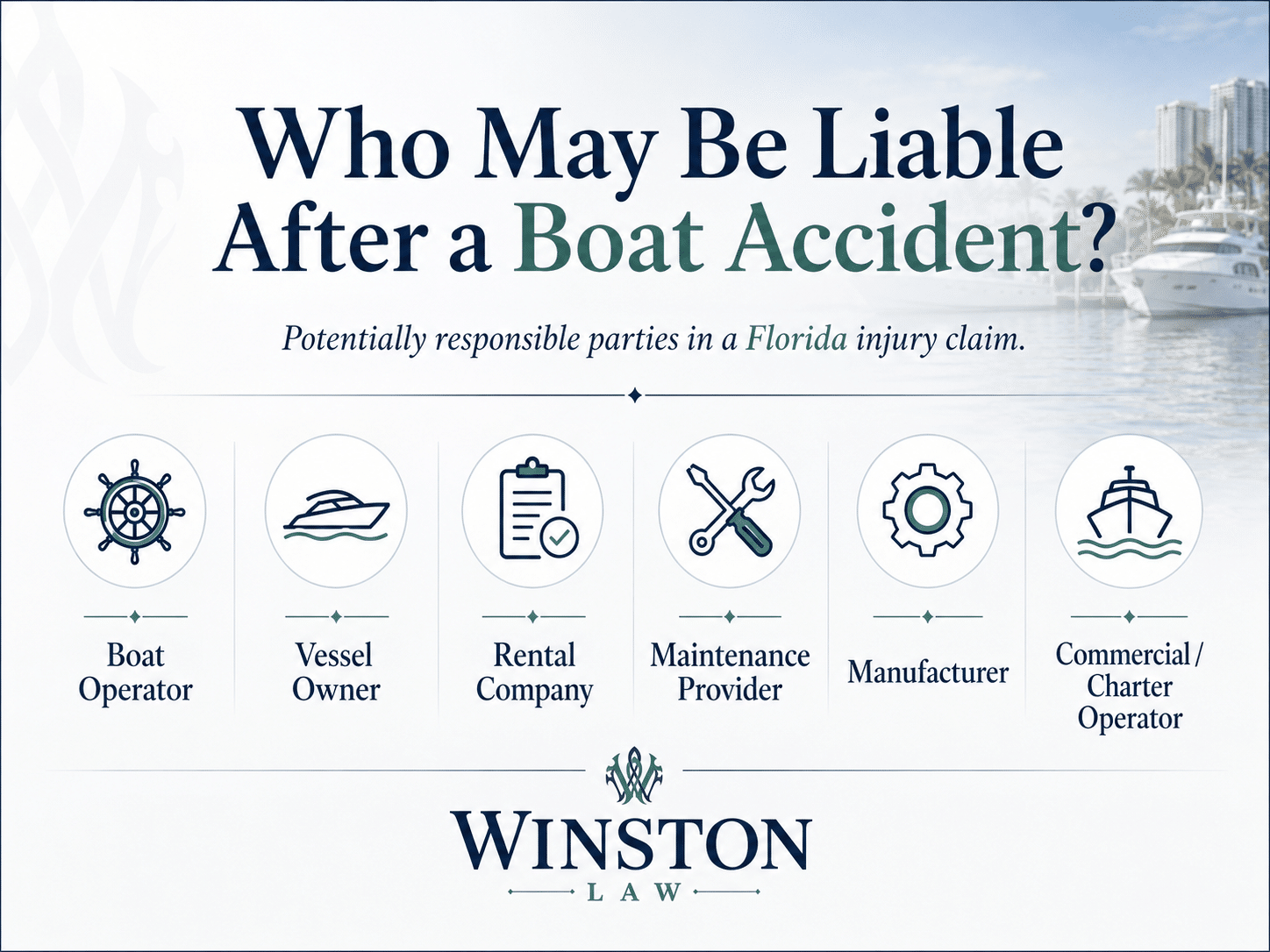
In many cases, liability may fall on a boat operator, vessel owner, rental company, maintenance provider, manufacturer, commercial operator, or another negligent party. Because boating accidents often happen on open water, crowded waterways, docks, marinas, canals, or offshore areas, determining fault may require a closer review of the full chain of events.
Common factors that may affect liability include:
- Operator behavior: The actions of the boat operator are often the starting point. Speed, lookout, attention to surroundings, passenger safety, and safe maneuvering can all affect liability. An operator who fails to keep a proper lookout, ignores other vessels, cuts across traffic, or makes an unsafe turn may be responsible if that conduct causes an injury.
- Right-of-way and navigation rules: Boat operators are expected to follow navigation rules designed to prevent collisions. Failing to yield, misjudging another vessel’s path, operating too close to other boats, or ignoring posted restrictions can become important evidence in a liability dispute.
- Alcohol or impairment: Alcohol and drug impairment can play a major role in boating accidents. Impairment can affect judgment, reaction time, speed control, and the ability to respond to changing water conditions. If an operator was impaired, that fact may become a central issue in both the injury claim and any related investigation.
- Speed and water conditions: Boaters must operate at a safe speed for the conditions, not simply at the highest speed they believe is allowed. Congested waterways, poor visibility, wake zones, weather changes, shallow areas, bridges, docks, swimmers, and other vessels may require slower and more cautious operation.
- Vessel maintenance and equipment condition: Mechanical failure, steering problems, engine issues, defective safety equipment, lighting problems, or missing required equipment may also contribute to an accident. Depending on the facts, responsibility may extend beyond the operator to the boat owner, maintenance provider, rental company, or manufacturer.
- Passenger safety: Some cases involve injuries to passengers who were thrown, struck, or knocked overboard, or who were injured while boarding or exiting a vessel. Operators and owners may be responsible when they fail to warn passengers, overload the vessel, operate recklessly, or ignore unsafe conditions.
- Commercial or rental operations: When the accident involves a charter boat, tour boat, rental vessel, jet ski rental, or other commercial operation, additional issues may arise. These cases may involve company policies, training practices, maintenance records, waivers, rental agreements, employee conduct, and insurance coverage.
Many boating accidents involve more than one contributing factor. For example, one operator may have been speeding while another failed to yield, or a rental company may have provided an inexperienced operator with a poorly maintained vessel. In Florida injury cases, fault may be apportioned among multiple parties based on their respective shares of responsibility.
Insurance and Liability Disputes
Insurance issues after a boat or watercraft accident in Fort Lauderdale can become just as complicated as the accident itself. Unlike standard car accident cases, boating coverage can vary widely depending on the type of vessel, where it was used, who operated it, whether it was privately owned or rented, and whether the activity was recreational or commercial.
Common insurance disputes after a boating accident include:
- Coverage interpretation: An insurer may question whether the vessel was being used for personal recreation, business, rental, charter, or another purpose. Even small differences in how the boat was used can affect whether a policy applies.
- Fault allocation: When multiple boats, operators, passengers, companies, or property owners are involved, insurers may try to shift responsibility away from their insured. This can lead to conflicting versions of events, especially when witness statements, marine reports, GPS data, photos, or videos are incomplete.
- Policy limits and exclusions: Some policies contain exclusions or restrictions related to alcohol use, passenger limits, operating zones, unlisted operators, commercial use, racing, rental activity, or failure to follow safety rules. Insurers may use policy language to delay, reduce, or deny payment.
- Multiple possible insurance sources: A boating accident may involve a boat insurance policy, homeowner’s policy, umbrella policy, commercial marine policy, rental agreement, marina policy, or other coverage. Identifying every potential source of recovery can be an important part of the claim.
- Evidence disagreements: Accident reconstruction, vessel damage, GPS records, marine patrol reports, photographs, video footage, weather conditions, and witness statements may all be used to support or challenge a claim. When insurers interpret the same evidence differently, resolving liability can take longer.
Because these claims often involve overlapping legal and insurance issues, it is important to review both the facts of the accident and the specific policy language involved. Winston Law can deal with insurers, investigate liability, and help injured clients pursue the compensation available under the circumstances.
What to Do After a Boat or Watercraft Accident in South Florida
The steps taken after a boating accident can affect both medical recovery and the strength of a legal claim. After a serious injury on the water, the priority should always be safety and medical attention. Once immediate danger has passed, preserving evidence becomes critical.
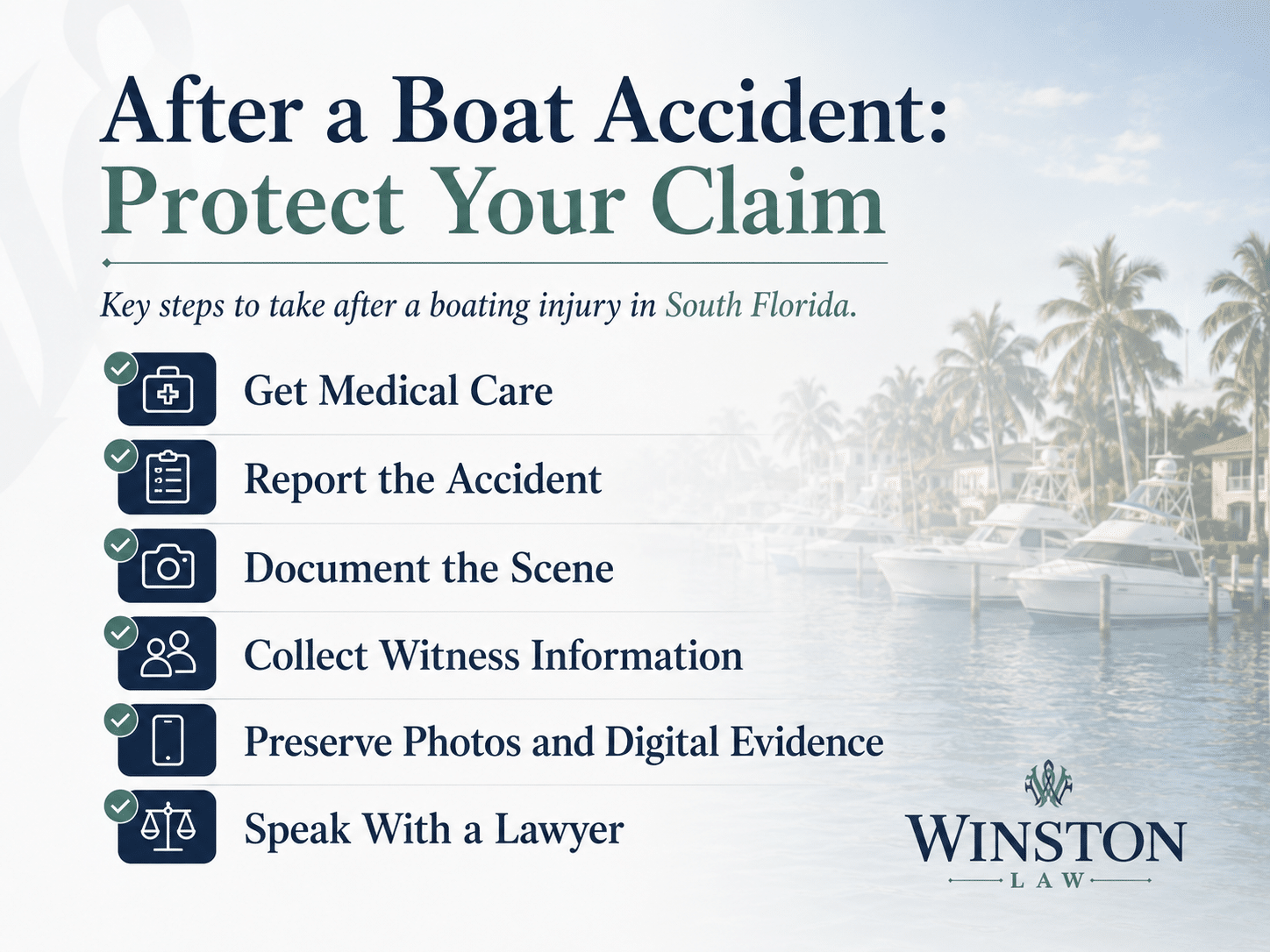 After a boat or watercraft accident, injured people should consider the following steps:
- Get medical care as soon as possible. Some injuries are obvious right away, while others may worsen after the adrenaline wears off. Head injuries, back injuries, neck injuries, fractures, internal injuries, and near-drowning injuries should be evaluated promptly.
- Report the accident when required. Depending on the circumstances, boating accidents may need to be reported to the proper authorities. Serious injuries, deaths, disappearances, and significant property damage can trigger reporting requirements.
- Document the scene. Photos and videos of the vessel, water conditions, injuries, the dock or marina area, visible damage, safety equipment, weather, location, and nearby boats may become important later.
- Collect witness and operator information. Names, phone numbers, vessel identification, insurance details, rental company information, marina information, and witness statements can help establish what happened.
- Preserve digital evidence. GPS data, phone videos, text messages, onboard electronics, reservation records, rental agreements, and photos from before and after the accident may help show location, speed, timing, and conduct.
- Avoid giving recorded statements too quickly. Insurance companies may ask questions in a way that minimizes injuries or shifts blame. Before giving a recorded statement, it is often wise to understand your rights and the potential effect on your claim.
- Speak with a personal injury lawyer early. A lawyer can help determine who may be liable, what insurance may apply, what evidence needs to be preserved, and how Florida law or maritime rules may affect the claim.
Boat accident claims can become harder to prove when evidence disappears, witnesses become difficult to reach, or vessels are repaired before damage is documented. Acting promptly can help protect your ability to pursue compensation.
Compensation After a Florida Boat Accident
The value of a boat accident claim depends on the severity of the injuries, the available insurance coverage, the strength of the liability evidence, and the long-term effect of the accident on the injured person’s life.
Compensation may include damages for:
- Medical bills
- Future medical care
- Lost wages
- Reduced earning ability
- Pain and suffering
- Physical limitations
- Emotional distress
- Scarring or disfigurement
- Loss of enjoyment of life
- Wrongful death damages, when a fatal accident occurs
Every case is different. A passenger injured on a private boat may have a different claim than someone hurt on a charter vessel, jet ski rental, dock, marina, or commercial watercraft. The type of vessel, the location of the accident, the people involved, and the available insurance coverage all matter.
Talk to a Fort Lauderdale Boat Accident Lawyer
If you were injured in a boat or watercraft accident in Fort Lauderdale, Broward County, or elsewhere in South Florida, you do not have to sort through liability, insurance, and legal deadlines on your own. These cases can involve multiple responsible parties, disputed versions of events, and insurance companies seeking to limit payment.
Winston Law can investigate what happened, identify the parties who may be responsible, review available insurance coverage, preserve important evidence, and help you pursue compensation for your injuries and losses.
If you were hurt on a boat, jet ski, charter, rental vessel, marina, dock, or South Florida waterway, schedule a consultation with Winston Law to discuss your legal options.
Frequently Asked Questions About Florida Boat Accident Claims
Who can be liable for a boat accident in Florida?
Liability for a Florida boat accident may fall on a boat operator, vessel owner, rental company, charter company, maintenance provider, manufacturer, marina, or another negligent party. The answer depends on who caused or contributed to the accident and whether their conduct fell below the level of reasonable care required under the circumstances.
Can I bring a claim if I was injured as a passenger on a boat?
Yes. Injured passengers may have a claim if the operator, boat owner, rental company, or another party caused or contributed to the accident. Passengers are often injured due to excessive speed, reckless operation, impairment, lack of warnings, overcrowding, poor maintenance, or unsafe boarding and docking conditions.
What if more than one person caused the boating accident?
More than one person or company can share responsibility for a boating accident. Fault may be divided among multiple parties, including operators of different vessels, a boat owner, a rental company, a maintenance provider, or another negligent party. The percentage of fault assigned to each party can affect the final recovery.
Do Florida boat accident claims involve insurance disputes?
Many boat accident claims involve insurance disputes. Coverage may depend on whether the vessel was privately owned, rented, used commercially, operated in a covered area, or subject to policy exclusions. Insurers may also dispute fault, damages, policy limits, or whether a particular policy applies.
How long do I have to file a Florida boat accident injury claim?
Many Florida negligence claims must be filed within two years, but boating accident cases can involve additional legal issues, including maritime law, wrongful death claims, insurance deadlines, and notice requirements. Because the applicable deadline can depend on the facts, injured people should speak with a lawyer as soon as possible after a serious boating accident.
Should I speak with the insurance company after a boat accident?
You should be cautious before giving a recorded statement or accepting a settlement from an insurance company. Insurers may ask questions that affect fault, injury severity, or coverage. A lawyer can help you understand what information must be provided and how to avoid statements that may be used against your claim.