



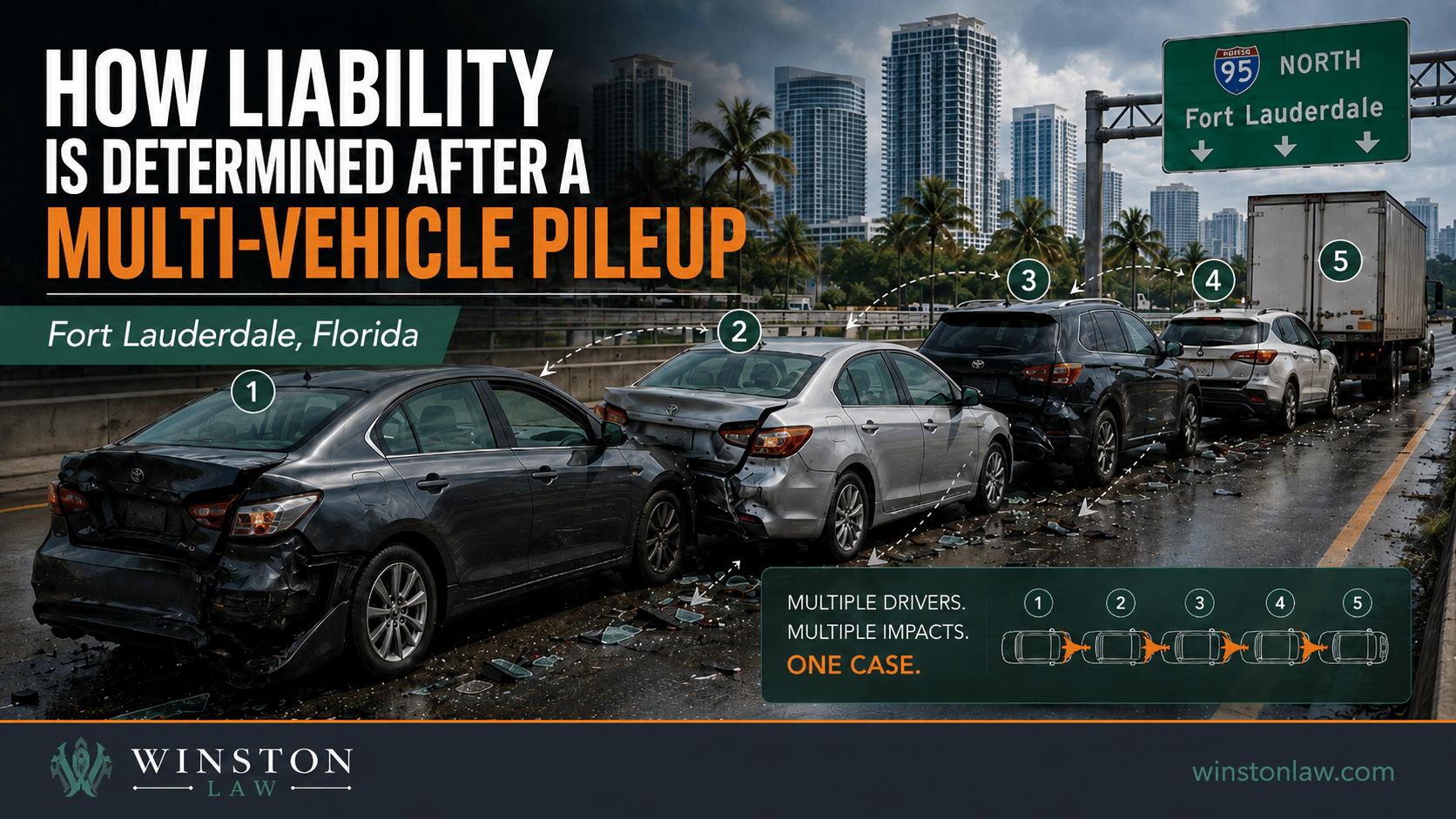
A multi-vehicle pileup is not simply a larger version of a two-car accident. When several vehicles collide, determining who caused which impact can become one of the most important—and most disputed—parts of the claim.
One driver may have triggered the first collision, another may have been following too closely, and a third may have been traveling too fast to stop safely. In other cases, one driver’s actions may be responsible for most or all of the crash. The answer depends on the evidence.
For an injured person, that distinction matters because Florida law can reduce compensation based on each party’s percentage of fault. Multiple insurance companies may also become involved, and each may have a financial reason to minimize its insured’s responsibility.
A Fort Lauderdale car accident lawyer at Winston Law can investigate the sequence of impacts, preserve physical and electronic evidence, identify all potentially responsible parties, and challenge attempts to place unfair blame on you.
Who Is at Fault in a Florida Chain-Reaction Crash?
There is no automatic rule that determines fault simply because one vehicle struck another in a pileup. Liability depends on what each driver was doing before and during the sequence of collisions.
Potential contributing factors may include:
- Following another vehicle too closely
- Speeding or driving too fast for traffic conditions
- Distracted driving
- Unsafe lane changes
- Failure to maintain a proper lookout
- Driving while impaired or fatigued
- Sudden braking or evasive maneuvers
- Unsafe roadway or weather conditions
- Commercial vehicle or trucking company negligence
In some crashes, one driver’s negligence may have started the entire chain reaction. In others, several drivers may share responsibility because their actions independently contributed to the injuries.
Why the Police Report Does Not Automatically Decide Liability
The crash report can be important evidence, but it does not automatically determine civil liability.
A responding officer typically arrives after the collision. The report may include driver statements, witness accounts, vehicle positions, citations, roadway observations, and the officer’s initial assessment of what occurred.
Those findings can be useful, but insurers, attorneys, experts, and ultimately a judge or jury may evaluate additional evidence that was not available to the responding officer.
In a pileup, this is especially important because several drivers may remember the sequence differently. A driver near the middle of the collision may feel one impact but not realize that another vehicle struck them moments earlier or afterward.
How Florida’s Comparative Fault Rule Can Affect a Multi-Vehicle Accident Claim
Florida follows a modified comparative fault system in most negligence cases.
Under Florida Statute § 768.81, an injured person’s damages may be reduced according to that person’s percentage of fault.
If the injured person is found to be more than 50% responsible for their own harm in an action covered by the statute, they generally cannot recover damages.
For example, if an injured person suffers $200,000 in damages but is found 30% responsible, the recoverable amount may be reduced by that percentage. If the person is found more than 50% responsible, recovery may be barred under the statute.
This is one reason fault allocation can become so important in a multi-vehicle crash. Several insurers may offer competing explanations of the same collision, and each percentage assigned can affect the final recovery.
How Fault May Be Divided Among Several Drivers
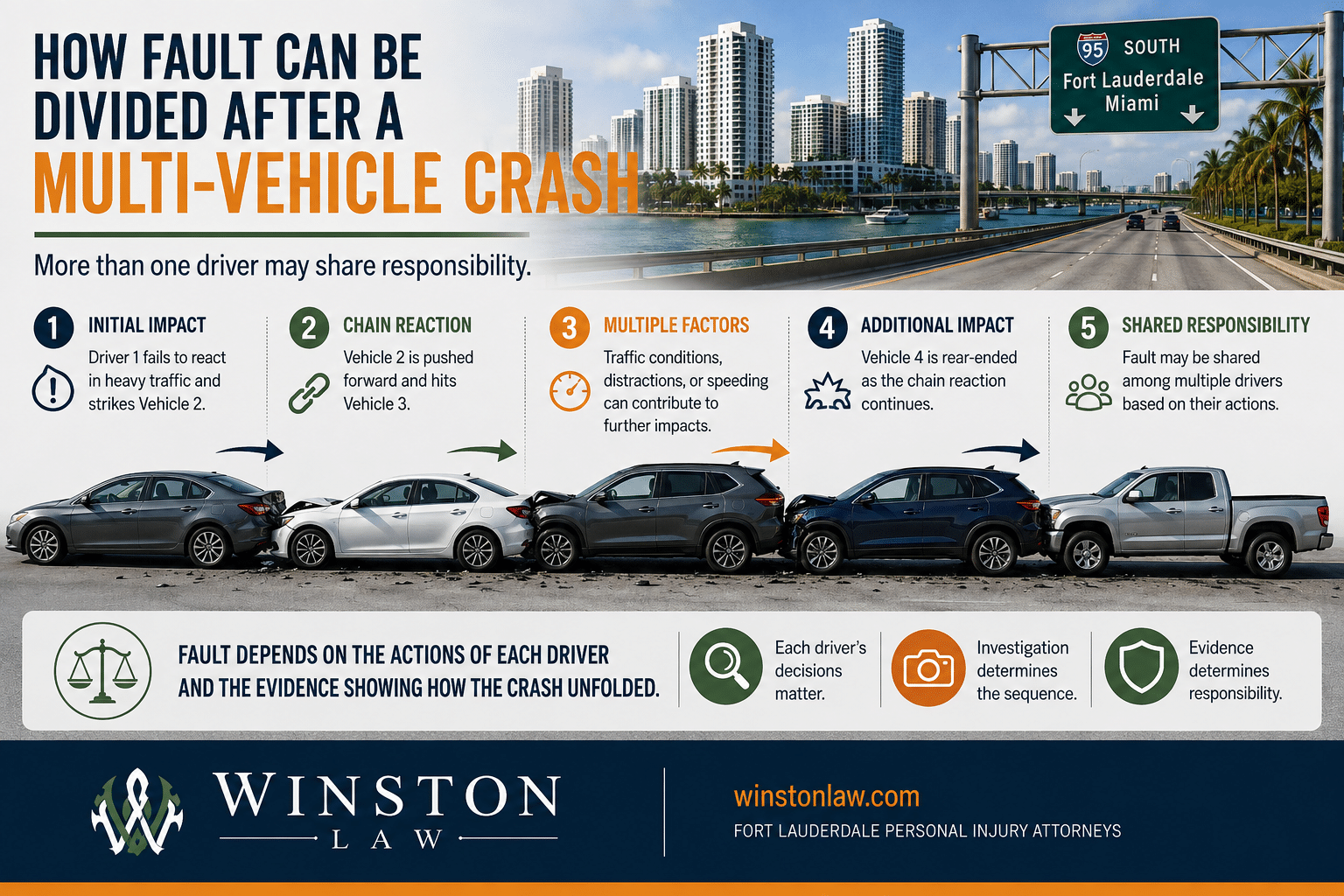
In a pileup, investigators may examine the conduct of every driver whose actions could have contributed to the sequence of impacts.
For example:
- Driver A may have caused the initial collision by making an unsafe lane change.
- Driver B may have been following too closely and unable to stop.
- Driver C may have been speeding and struck already-disabled vehicles.
- Another driver may have had enough time to stop and avoided responsibility altogether.
The percentages are not assigned simply because a vehicle was physically involved. The question is whether a person’s negligent conduct contributed to the injuries.
That distinction can be critical when several drivers and insurance carriers are involved.
Why Each Defendant’s Share of Fault Matters
Florida’s comparative fault system generally requires responsibility to be allocated according to each party’s percentage of fault rather than automatically requiring one defendant to pay for another defendant’s share.
That can create practical problems when one of the responsible drivers has limited insurance, no applicable bodily injury coverage, or insufficient assets to satisfy the claim.
For example, if a substantial percentage of fault is assigned to an uninsured or underinsured driver, the injured person may need to investigate whether other coverage is available, including uninsured or underinsured motorist coverage.
Our Fort Lauderdale uninsured motorist accident lawyers can review the applicable policies when insurance coverage becomes an issue after a multi-vehicle collision.
What Evidence Helps Establish the Order of Impacts?
Determining the sequence of impacts is often one of the most important parts of a pileup investigation.
Driver statements can help, but physical and electronic evidence may provide a more reliable picture of what happened.
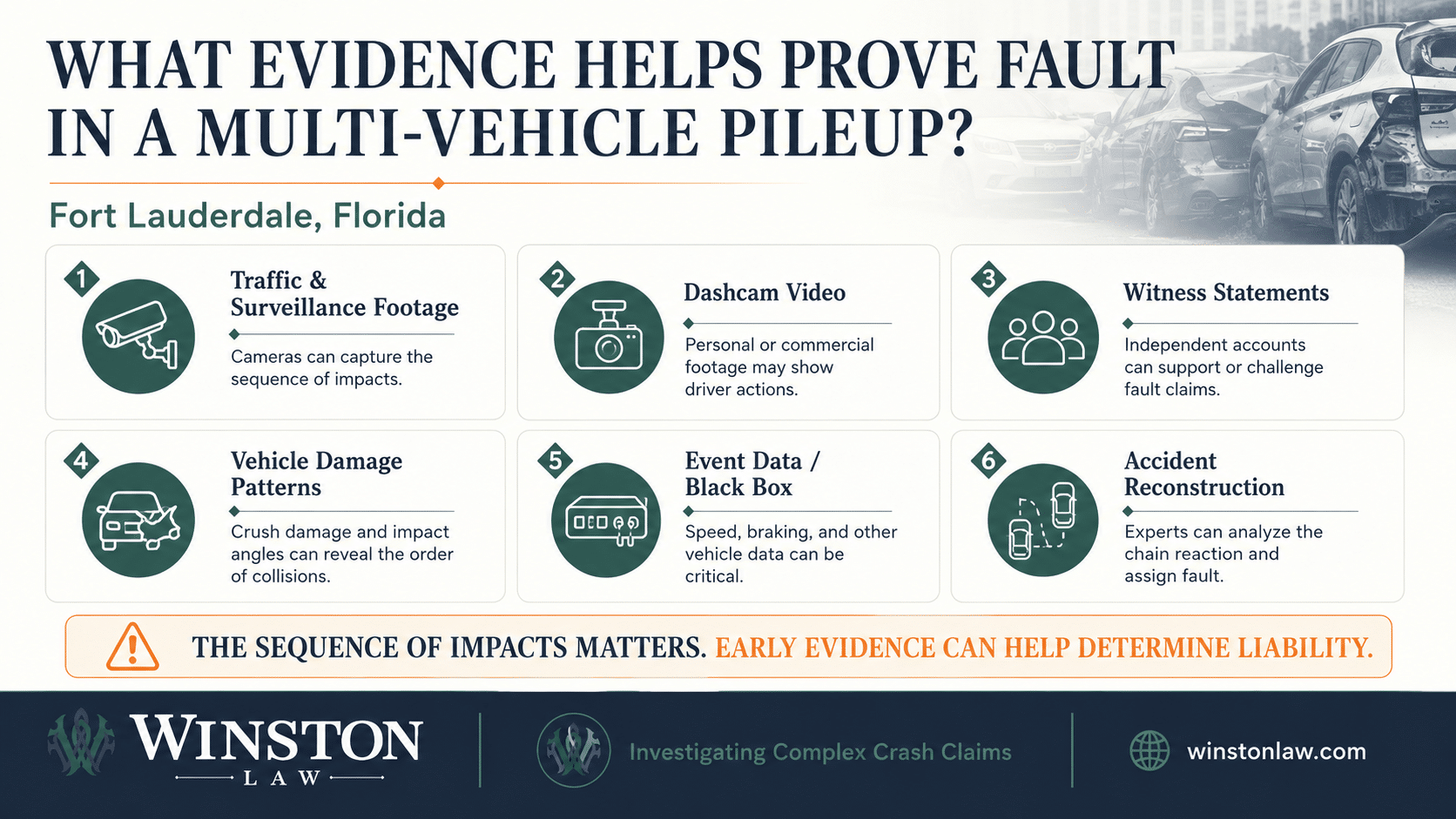
Evidence may include:
- Event data recorder information showing speed, braking, throttle, and other vehicle data
- Commercial vehicle telematics and electronic logging data
- Dashcam and helmet-camera footage
- Traffic-camera and nearby surveillance footage
- Vehicle damage and crush patterns
- Skid marks, debris fields, gouge marks, and final vehicle positions
- Photographs and video taken before the roadway is cleared
- Witness statements
- 911 call timing and dispatch records
- Cell phone records when distracted driving is suspected
- Accident reconstruction analysis
No single piece of evidence necessarily determines the entire case. Investigators often compare several sources to reconstruct the sequence of events.
Why Vehicle Damage Can Tell the Story of a Pileup
Damage patterns can help establish where and how vehicles made contact.
For example, damage to both the front and rear of one vehicle may support a different sequence than damage limited to the rear. Crush depth, impact angle, transferred paint, broken components, and debris may also help experts determine which impacts occurred first and which happened later.
This is one reason damaged vehicles should not be repaired, salvaged, or destroyed before important evidence has been documented when liability is seriously disputed.
Why Electronic Data Matters in Modern Multi-Vehicle Crashes
Modern vehicles can contain electronic information that may become important after a serious accident.
Depending on the vehicle, event data may help show:
- Vehicle speed shortly before impact
- Whether and when brakes were applied
- Throttle position
- Seat belt use
- Changes in vehicle speed during the collision
Commercial trucks and fleet vehicles may contain additional telematics, GPS, dispatch, driver-hour, and safety information.
Because some electronic information can be lost or overwritten, preservation requests may need to be sent quickly.
Can a Trucking Company or Employer Share Liability in a Pileup?
Yes. When a commercial vehicle is involved, responsibility may extend beyond the individual driver.
A trucking company or employer may need to be investigated for issues involving:
- Negligent hiring or retention
- Inadequate driver training
- Unsafe scheduling or fatigue
- Poor vehicle maintenance
- Failure to enforce safety policies
- Other conduct that contributed to the crash
Commercial vehicle cases can also involve larger insurance policies and additional records that are not present in ordinary passenger-vehicle claims.
Winston Law’s Fort Lauderdale truck accident lawyers investigate both driver conduct and company-level decisions when a commercial vehicle contributes to a serious collision.
What If a Dangerous Roadway Contributed to the Pileup?
Not every chain-reaction crash is caused solely by the drivers involved.
Roadway design, construction zones, standing water, poor drainage, missing signage, defective traffic controls, debris, or other hazardous conditions may contribute to a crash.
When roadway conditions played a role, we may need to investigate additional entities. Claims involving governmental agencies or contractors can involve different notice requirements and procedures, so early review is important.
Our attorneys may also investigate whether a defective roadway contributed to the collision.
Several Insurance Companies May Be Involved
A multi-vehicle crash can involve several insurance companies, each conducting its own investigation and evaluating its insured’s responsibility.
This can lead to competing fault arguments.
One insurer may claim another driver caused the initial collision. Another may argue that later impacts caused the most serious injuries. A third may contend that the injured person could have avoided the crash.
These competing positions are why it is important to preserve independent evidence rather than relying solely on statements collected by insurers.
Can Later Impacts Cause Additional Injuries?
Yes. In a chain-reaction crash, a person may experience more than one collision.
The first impact may damage the vehicle and injure an occupant, while a later impact from another direction may cause additional trauma.
Medical evidence and accident reconstruction may become important when insurers dispute which impact caused a particular injury or try to shift responsibility to another driver.
Doctors, imaging studies, vehicle damage, crash forces, and expert analysis may all help explain how the sequence of impacts relates to the injuries.
What Should You Do After a Multi-Vehicle Pileup in Fort Lauderdale?
Your health and immediate safety come first. Pileups can leave vehicles in active travel lanes and create the risk of additional collisions.
When circumstances allow:
- Call 911 and report the crash.
- Seek medical evaluation for your injuries.
- Take photographs and video of all involved vehicles and the roadway.
- Photograph debris, skid marks, traffic controls, and vehicle positions before they are moved when it is safe to do so.
- Collect names and contact information from witnesses.
- Preserve dashcam or other personal video.
- Keep copies of medical records, towing documents, repair records, and insurance correspondence.
- Be cautious about giving detailed recorded statements before you understand the full sequence of the crash.
You do not need to determine every driver’s percentage of fault while standing at the accident scene. You can do that analysis after the available evidence has been preserved.
How Long Do You Have to File a Florida Car Accident Lawsuit?
Florida generally provides a two-year statute of limitations for negligence actions under Florida Statute § 95.11.
The applicable deadline can depend on the date of the crash and the specific type of claim involved. Florida changed the general negligence limitations period in 2023, so older accidents may require separate analysis.
More importantly, evidence can disappear long before the lawsuit deadline. Vehicles may be repaired or salvaged, electronic information can be overwritten, surveillance footage may be deleted, and witnesses may become difficult to locate.
Why Multi-Vehicle Accident Claims Require Early Investigation
The longer a pileup case goes without a coordinated investigation, the easier it becomes for important evidence to disappear and competing versions of events to harden.
Early investigation can help:
- Preserve the involved vehicles
- Obtain electronic vehicle data
- Locate surveillance and dashcam footage
- Identify every potentially responsible driver
- Determine available insurance coverage
- Document roadway and weather conditions
- Interview witnesses while memories are fresh
- Evaluate whether accident reconstruction is necessary
Frequently Asked Questions About Multi-Vehicle Pileups in Florida
Who Is at Fault in a Multi-Car Pileup in Florida?
Fault in a multi-vehicle pileup depends on the evidence showing how the collision developed. One driver may have caused the initial crash, several drivers may have contributed to later impacts, or one person may ultimately be responsible for most of the collision. Police reports, vehicle damage, witness statements, electronic vehicle data, video footage, and accident reconstruction may all help determine fault.
Can More Than One Driver Be Responsible for a Chain-Reaction Crash?
Yes. More than one driver can share responsibility for a chain-reaction collision if the evidence shows that each driver’s negligence contributed to the crash or the resulting injuries. Florida’s comparative fault rules allow responsibility to be divided among the parties based on their individual percentages of fault.
Does the First Driver Who Crashes Always Cause the Entire Pileup?
No. The driver who causes the first impact may be responsible for starting the sequence, but later drivers may also contribute if they were following too closely, speeding, distracted, or otherwise unable to respond safely. The entire sequence must be investigated before responsibility can be fairly assigned.
What Evidence Helps Prove Fault in a Multi-Vehicle Accident?
Important evidence can include crash-scene photographs, surveillance footage, dashcam video, witness statements, vehicle damage patterns, event data recorder information, commercial vehicle telematics, cell phone records, roadway evidence, and accident reconstruction analysis. The most useful evidence depends on the circumstances of the collision.
What Happens If One of the At-Fault Drivers Has No Insurance?
If one of the responsible drivers is uninsured or does not have enough coverage, recovery may depend on other available insurance, including uninsured or underinsured motorist coverage. Other responsible parties or insurance policies may also need to be investigated depending on how the crash occurred.
Put a Fort Lauderdale Car Accident Lawyer on Your Pileup Claim
A multi-vehicle crash can involve several drivers, several insurance companies, conflicting accounts, and complicated questions about which impact caused which injuries.
Winston Law can investigate the sequence of collisions, preserve physical and electronic evidence, identify potentially responsible parties, evaluate insurance coverage, and challenge attempts to assign you an unfair share of the blame.
Our attorneys represent people injured in serious car and highway accidents throughout Fort Lauderdale and Broward County.
If you were injured in a chain-reaction crash or multi-vehicle pileup, contact Winston Law to schedule a free consultation.