



Fort Lauderdale e-scooter and micromobility accident claims are generally handled under Florida negligence law, and many negligence lawsuits must be filed within two years. Under Florida law, motorized scooter operators generally have the rights and duties of bicycle riders, and a scooter does not require a driver’s license, vehicle registration, or the insurance required for many conventional motor vehicles.
Those rules can make scooter accidents more complicated than ordinary car crashes. Insurance coverage may depend on whether a motor vehicle struck a rider, a scooter struck a pedestrian, a rental company was involved, or defective equipment contributed to the crash.
Common cases include riders hit by cars, pedestrians struck on sidewalks, e-bike crashes, single-rider falls caused by dangerous conditions, and accidents involving defective scooters. A Fort Lauderdale personal injury lawyer at Winston Law Firm can review how the accident happened and which Florida laws and insurance policies may apply.
How Florida Law Defines E-Scooters and Micromobility Devices
Florida law now uses a broad definition of a micromobility device. The term generally covers transportation devices designed for individual use that meet specified size, weight, and speed requirements and can include bicycles, electric bicycles, motorized scooters, individually owned devices, and devices in shared fleets.
A motorized scooter has a more specific definition. Under Florida law, it is generally a motor-powered vehicle or micromobility device with no more than three wheels that cannot propel itself faster than 20 mph on level ground. The definition excludes an electric bicycle.
Electric bicycles have their own classifications. Class 1 and Class 2 e-bikes provide motor assistance up to 20 mph, while a Class 3 electric bicycle can provide pedal assistance up to 28 mph.
Florida traffic law generally excludes electric bicycles and motorized scooters from its definition of a conventional motor vehicle. That distinction can affect licensing, registration, insurance requirements, and post-accident coverage.
Micromobility crashes are also a growing safety concern. The U.S. Consumer Product Safety Commission estimated approximately 79,300 emergency-department-treated e-scooter injuries in 2024. Federal data found that most estimated e-scooter injuries involved riders, not people struck by them.
E-Scooter Rider Rights and Duties on Fort Lauderdale Streets
Under Florida’s scooter and micromobility law, a motorized scooter or micromobility device operator generally has the same rights and duties as a bicycle rider, subject to statutory exceptions and local regulations.
That means scooter riders must follow many of the same traffic rules as bicycle riders. For example, a rider traveling slower than normal traffic on a roadway generally must use an available bicycle lane or remain as close as practicable to the right side of the roadway, subject to exceptions for turns, passing, hazards, unsafe lane conditions, and other circumstances.
Florida law also allows local governments to regulate micromobility devices and motorized scooters on streets, sidewalks, and other areas within their jurisdiction.
Fort Lauderdale’s published dockless mobility guidelines state that dockless scooters are authorized for use on sidewalks. The City’s guidelines instruct riders to yield to pedestrians, obey traffic laws, ride one person per scooter or bicycle, and avoid drinking and riding.
The City also instructs users to park scooters upright and leave at least 4 feet of clear sidewalk space rather than blocking wheelchair ramps, business entrances, fire hydrants, parking areas, or street furniture.
Because scooter riders share many of the same roadway duties as cyclists, these cases frequently overlap with bicycle and e-bike accident claims in Fort Lauderdale.
Riders can also review Winston Law Firm’s Florida e-bike safety tips for information about visibility, roadway hazards, lighting, and safer riding practices.
What Happens When a Car Hits an E-Scooter Rider?
A motor vehicle driver can be liable when negligence causes a collision with an e-scooter rider. Depending on the circumstances, negligence may include:
- Failing to yield at an intersection or crosswalk
- Turning across a bicycle lane or rider’s path
- Driving while distracted
- Speeding or driving too fast for conditions
- Following a scooter too closely
- Opening a vehicle door into the path of a rider
- Driving while impaired
- Failing to keep a proper lookout for riders
A scooter rider’s conduct can also factor into the liability analysis. Investigators and insurers may consider where the rider was traveling, traffic signals, visibility, lighting, speed, right-of-way, and whether either party violated an applicable traffic rule.
These crashes can raise many of the same liability questions as Fort Lauderdale car accident claims, but the insurance analysis may differ because the injured person was riding a scooter rather than occupying a conventional motor vehicle.
Pedestrian Rights When an E-Scooter Hits You in Fort Lauderdale
Pedestrians have important protections when scooters are operated on sidewalks and other pedestrian areas.
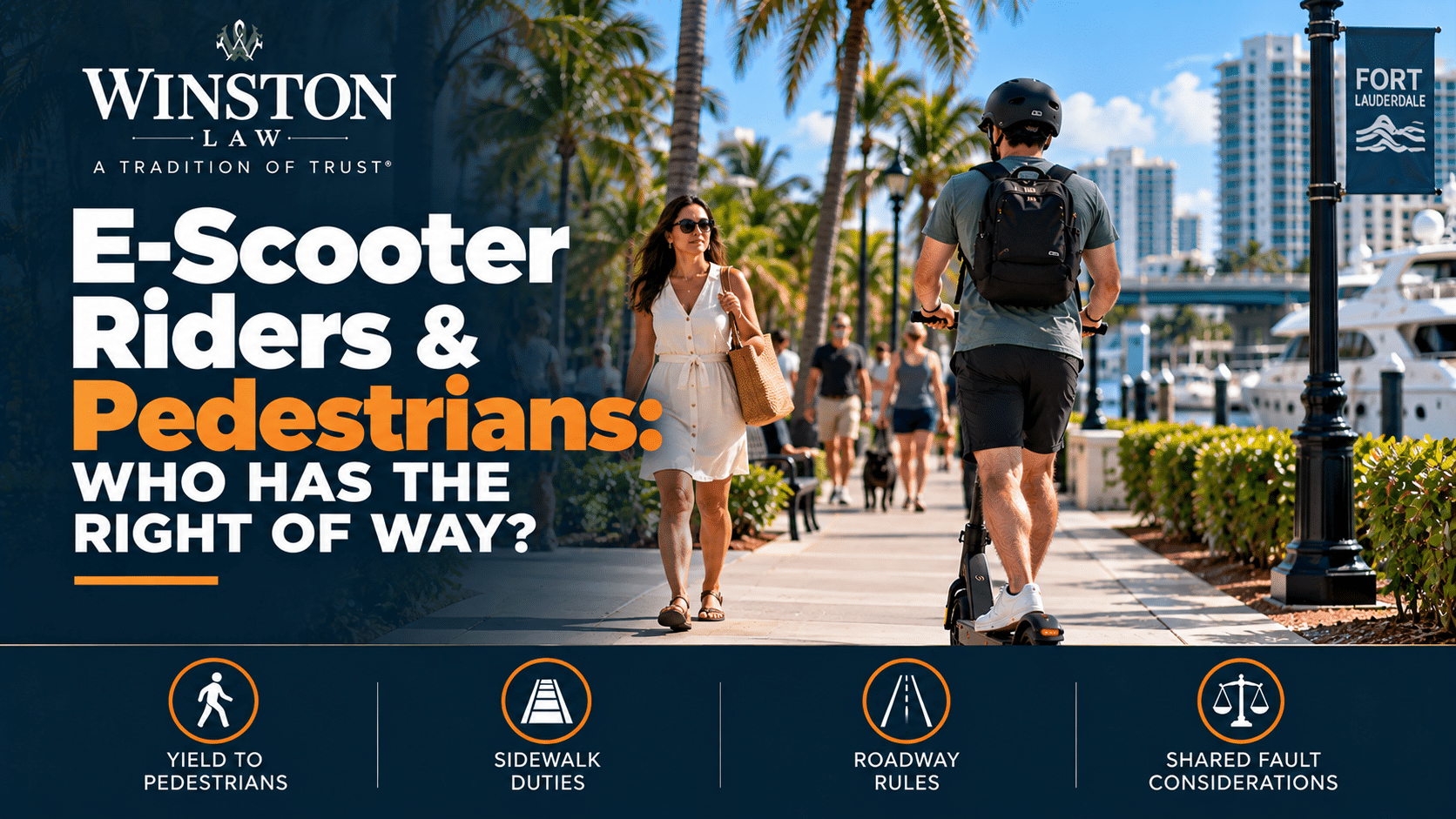
Florida bicycle rules require sidewalk riders to yield the right-of-way to pedestrians and give an audible signal before overtaking or passing them. Motorized scooter operators generally assume the rights and duties of bicycle riders, while Fort Lauderdale’s dockless mobility guidelines specifically instruct scooter riders to yield to pedestrians.
A scooter rider who travels too fast for the conditions, fails to yield, passes a pedestrian unsafely, or otherwise operates carelessly may be found negligent if that conduct causes an injury.
Pedestrian-scooter collisions can cause serious injuries because pedestrians have virtually no physical protection. Falls can result in fractures, head injuries, shoulder injuries, knee injuries, spinal injuries, and other trauma.
Someone injured while walking may benefit from speaking with a Fort Lauderdale pedestrian accident lawyer about the available evidence and potential sources of compensation.
Can a Rental Scooter Company Be Responsible for an Accident?
Rental scooters can add another layer to an injury investigation.
A scooter from a rental fleet doesn’t automatically make the rental company responsible for a rider’s negligence. However, depending on the facts, questions may arise concerning:
- Scooter inspection and maintenance
- Brake or steering problems
- Damaged tires or wheels
- Known mechanical defects
- Software or electronic malfunctions
- How and where scooters were placed or parked
- Whether the company received prior reports about a dangerous scooter
The rental agreement and app records may also contain useful information about the particular scooter, trip, rider, and time of the crash. Preserving that information becomes important when the scooter’s condition is disputed.
What If a Defective E-Scooter Causes the Crash?
Not every scooter accident is caused by a careless driver or rider. Mechanical and product failures can also cause serious crashes.
Possible defects can involve:
- Brakes
- Throttle controls
- Steering components
- Wheels and tires
- Frames or folding mechanisms
- Batteries
- Electronic controls or software
When a mechanical failure may have contributed to an accident, preserving the scooter can be particularly important. Repairing, discarding, returning, or altering the device before inspection may destroy important evidence.
Depending on what an investigation shows, a defective scooter claim may involve a manufacturer, distributor, retailer, repair company, rental fleet operator, or another business. Winston Law Firm also handles Florida product liability claims involving allegedly defective products.
Insurance Gaps in Florida E-Scooter and Micromobility Accidents
Insurance can be one of the most complicated parts of an e-scooter accident claim.
Florida does not require a motorized scooter or micromobility device to satisfy the registration and insurance requirements that apply to many conventional motor vehicles. A scooter rider therefore may not have a liability policy specifically covering scooter operation.
That can create a significant problem when a scooter rider injures a pedestrian and no obvious insurance policy covers the rider’s negligence.
Does Florida PIP Cover an E-Scooter Accident?
The answer depends heavily on how the crash occurred and which insurance policies apply.
Florida’s Personal Injury Protection system covers injuries arising from the use of qualifying motor vehicles. PIP policies can provide benefits to certain insured people and can also cover qualifying people who are struck by an insured motor vehicle while they are not occupying another self-propelled vehicle.
Florida PIP generally provides up to $10,000 in combined medical and disability benefits, subject to statutory requirements and limitations. PIP generally reimburses covered medical expenses at 80%, qualifying disability benefits at 60%, and requires initial qualifying medical care within 14 days of the motor vehicle accident.
A person riding an e-scooter who is struck by a car should not assume either that PIP automatically applies or that it never applies. Priority rules, the injured person’s household insurance, ownership of other vehicles, the type of device involved, and the circumstances of the collision can affect which policy may owe benefits.
Separate liability coverage from the motor vehicle driver may also be important when the driver’s negligence caused the collision.
What Evidence Matters After a Fort Lauderdale Scooter Accident?
Micromobility crashes can happen quickly, and some of the most useful evidence can disappear just as quickly.
Depending on the accident, important evidence may include:
- Photos and video of the scene
- Damage to the scooter, bicycle, or vehicle
- Surveillance or dashcam footage
- Witness names and contact information
- Police or incident reports
- Rental-app and trip information
- The scooter’s identification number
- Maintenance and inspection records
- Medical records and bills
- Evidence of lost income
- Traffic signals, signage, and roadway markings
- Photos showing sidewalk or roadway conditions
If a rented or defective scooter may be involved, identifying the specific device before it is placed back into service can be particularly important.
How Florida Comparative Fault Applies to E-Scooter Claims
Florida uses a modified comparative-fault system for many negligence actions.
If an injured person shares responsibility for an accident, recoverable damages generally reduce by that person’s percentage of fault. In negligence actions covered by Florida’s comparative-fault statute, a claimant who is found to be more than 50% responsible for his or her own harm generally cannot recover damages.
For example, fault may be disputed if a driver failed to yield but the scooter rider was also traveling against traffic, ignoring a signal, riding without adequate visibility, or operating carelessly around pedestrians.
The percentages an insurance company assigns are not necessarily the final determination of legal fault. Photographs, video, witnesses, traffic rules, electronic data, and other evidence can all affect the analysis.
How Long Do You Have to File a Florida E-Scooter Accident Claim?
Florida’s general statute of limitations for an action founded on negligence is currently two years.
That doesn’t mean every scooter-related claim has the same deadline. The applicable period can depend on when the claim accrued, the type of defendant, the legal theory involved, possible tolling rules, and other circumstances.
A claim involving a government entity, for example, may require additional notice and procedural steps. A defective-product claim can also raise issues beyond ordinary negligence.
Because evidence can disappear long before a filing deadline expires, injured people should not use the statute of limitations to delay investigating a serious crash.
Florida’s Micromobility Rules Continue to Evolve
Florida lawmakers considered additional statewide micromobility rules during the 2026 legislative session.
Senate Bill 382 included additional proposed rules on e-bikes on shared pathways and pedestrian areas, along with micromobility safety and crash-data provisions.
The bill passed both chambers of the Florida Legislature, but the Governor vetoed it on June 25, 2026. As a result, riders and pedestrians should continue to follow current Florida statutes and applicable local Fort Lauderdale rules rather than assuming the proposed 2026 requirements became law.
What Should You Do After an E-Scooter or Micromobility Accident?
If you are injured in a scooter, e-bike, or pedestrian collision, practical steps can help preserve both your health and potential claim:
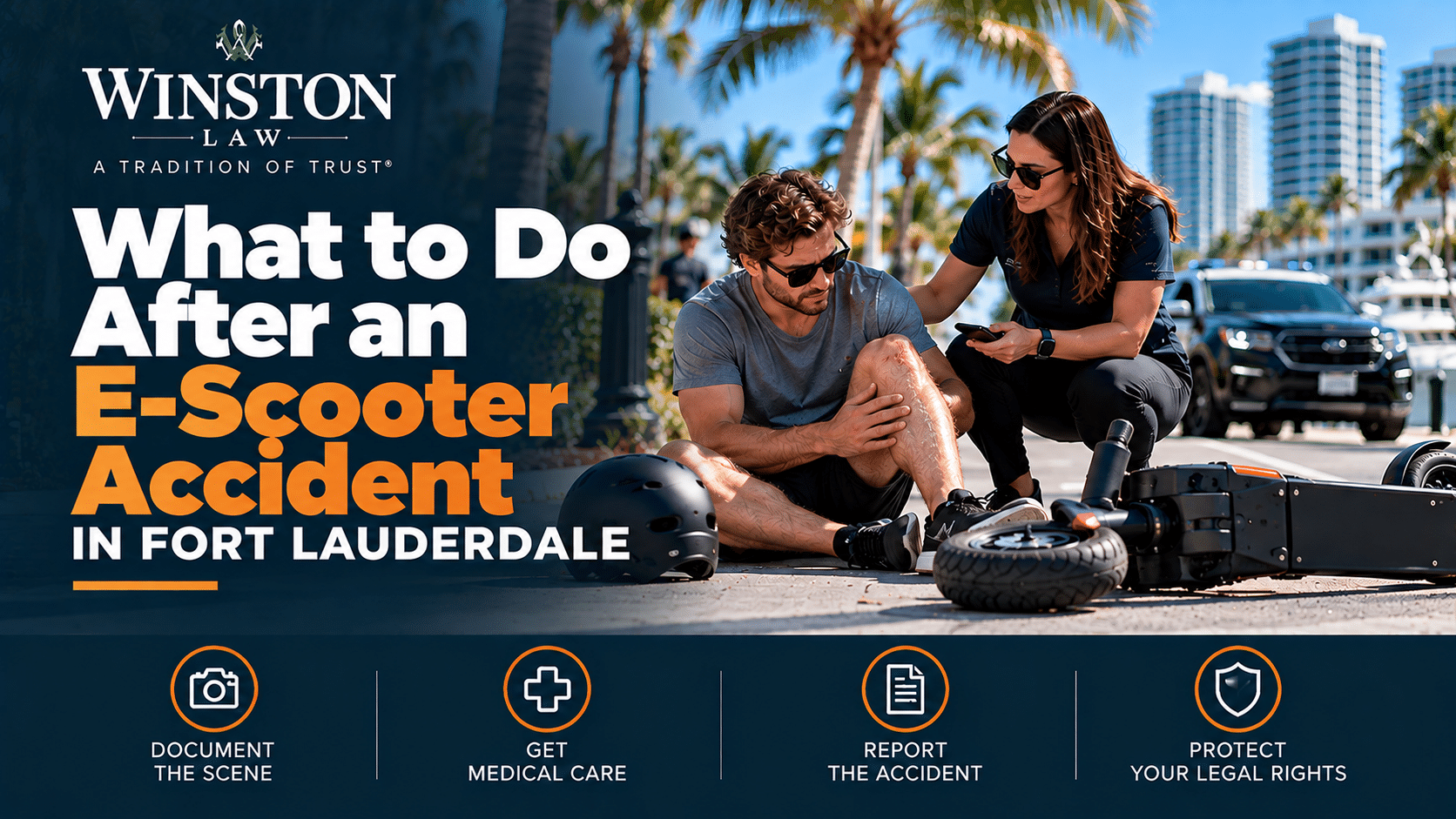
- Get appropriate medical attention. Some injuries may not be obvious immediately after the crash.
- Report the accident. Depending on the circumstances, that may include law enforcement, a property owner, or the scooter rental company.
- Photograph the scene and device. Capture vehicle positions, damage, roadway or sidewalk conditions, signs, signals, and the scooter identification number.
- Identify witnesses. Obtain names and contact information when possible.
- Preserve app information. Save trip receipts, screenshots, emails, and communications with a rental provider.
- Do not discard a privately owned scooter involved in a possible defect claim. The device itself may become important evidence.
- Identify available insurance. Depending on the crash, you may need to investigate PIP, automobile liability coverage, uninsured or underinsured motorist coverage, homeowners coverage, business insurance, or another policy.
Recover After a Scooter Crash With a Fort Lauderdale E-Scooter Accident Lawyer
E-scooter and micromobility accidents do not always fit neatly into the rules that apply to traditional motor vehicle crashes. Liability can involve a careless driver, scooter rider, rental operator, property owner, manufacturer, or multiple parties, and insurance coverage may depend on how the crash occurred.
Winston Law Firm has represented injured Floridians since 1989. We can investigate how a scooter or e-bike accident happened, preserve important evidence, review available insurance policies, and determine whether a rental operator, manufacturer, motor vehicle driver, or another party may be legally responsible.
If you were injured while riding an e-scooter or e-bike, or if a micromobility device struck you while you were walking, let Winston Law Firm know what happened or call (954) 475-9666 for a free consultation.
