



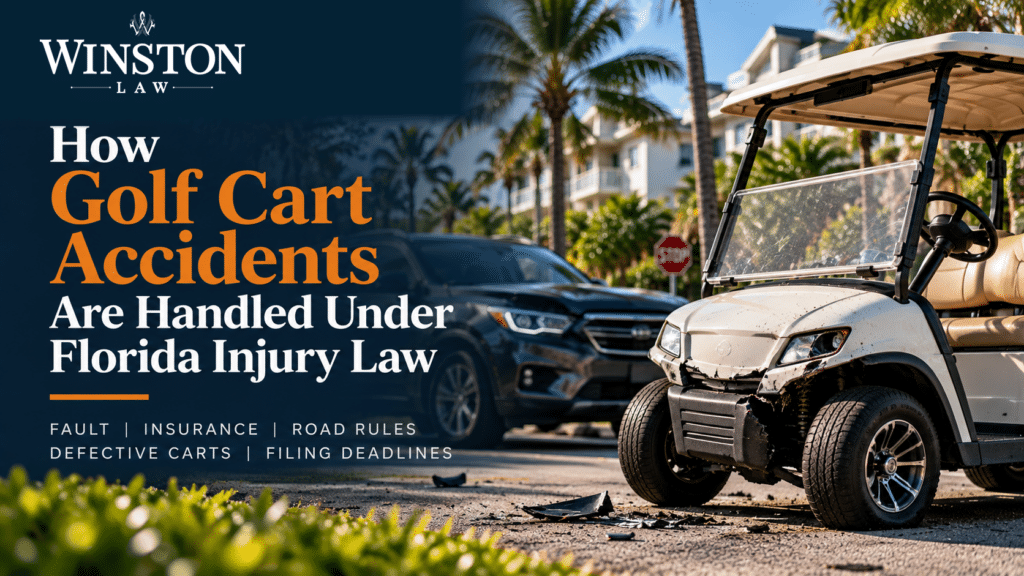
Florida golf cart accidents are generally handled as negligence-based personal injury claims, but the rules can change depending on the type of vehicle involved, where the crash occurred, who owned the cart, and what insurance coverage is available.
One of the first questions is whether the vehicle was legally a golf cart or a low-speed vehicle. Florida treats those vehicles differently for registration, insurance, equipment, and roadway use. A crash involving another car, an injured pedestrian, a rollover, a rental cart, or a defective component can also create different potential claims.
If you were injured in a golf cart accident in South Florida, a Fort Lauderdale personal injury lawyer at Winston Law Firm can investigate how the crash occurred, identify potentially responsible parties, and determine which insurance policies may apply.
How Florida Law Defines a Golf Cart and a Low-Speed Vehicle
Florida law distinguishes between a standard golf cart and a low-speed vehicle.
Under Florida Statute § 320.01, a golf cart is a motor vehicle designed and manufactured for operation on a golf course for sporting or recreational purposes that is not capable of exceeding 20 miles per hour.
A low-speed vehicle, sometimes called an LSV, is a four-wheeled vehicle with a top speed greater than 20 miles per hour but not greater than 25 miles per hour.
That difference matters after an accident.
- Standard golf carts operated in accordance with Florida’s golf-cart statutes are generally exempt from vehicle registration requirements.
- Low-speed vehicles must be registered, titled, insured, and equipped with additional safety equipment.
- Low-speed vehicle operators must possess a valid driver’s license.
Florida’s low-speed vehicle rules are found in Florida Statute § 316.2122.
Because the legal classification affects registration and insurance requirements, investigators should identify the vehicle type early in any golf cart accident investigation.
Florida Golf Cart Road Rules Can Affect Fault
Florida does not allow standard golf carts to travel freely on every public roadway.
Under Florida Statute § 316.212, golf carts generally may operate on county roads, municipal streets, or certain other roads only when the appropriate governmental entity has designated them for golf cart use.
The statute also establishes several operating and equipment requirements.
Daytime and Nighttime Operation
A golf cart generally may be operated only between sunrise and sunset unless the responsible local governmental entity allows nighttime operation.
When nighttime operation is authorized, the golf cart must have equipment that includes:
- Headlights
- Brake lights
- Turn signals
- A windshield
Required Safety Equipment
Florida law requires golf carts operated under the statute to have:
- Efficient brakes
- Reliable steering
- Safe tires
- A rearview mirror
- Red reflectorized warning devices in the front and rear
Age and Identification Requirements
Since October 1, 2023, a person under 18 generally cannot operate a golf cart on public roads or streets unless the person has a valid learner’s permit or driver’s license.
An operator who is 18 or older must have valid government-issued photo ID.
Violating a roadway or equipment rule does not automatically decide every injury case, but it can become important evidence when determining how a crash occurred and whether an operator acted negligently.
Who Can Be Responsible for a Florida Golf Cart Accident?
Responsibility depends on the crash’s facts. Some cases involve one negligent driver, while others require investigating an owner, rental operator, property owner, manufacturer, or multiple parties.
The Golf Cart Driver
A driver may be responsible when careless operation causes an accident. Examples can include:
- Driving too fast for conditions
- Failing to yield
- Distracted driving
- Unsafe turns
- Overloading the cart
- Allowing passengers to ride unsafely
- Operating at night without required equipment
- Operating on a road where golf carts are not authorized
The Golf Cart Owner
Ownership can also matter. Florida courts have applied the state’s dangerous instrumentality doctrine to golf carts in certain circumstances, including a Florida Supreme Court case involving negligent golf-cart operation on a golf course.
Owner liability should not automatically attach in every golf-cart accident. Courts must evaluate the location, ownership arrangement, permission to operate the vehicle, and the facts surrounding the crash.
A Rental Company, Resort, Business, or Property Owner
Golf carts are frequently used at golf courses, resorts, residential communities, commercial properties, events, and recreational facilities.
Depending on the facts, a business or property operator may be investigated for issues such as negligent maintenance, unsafe rental practices, allowing an unqualified person to operate a cart, or creating an unsafe traffic environment.
Claims involving unsafe property conditions may also overlap with Florida premises liability law. Learn more from Winston Law Firm’s Fort Lauderdale premises liability lawyers.
The Golf Cart or Component Manufacturer
A mechanical defect can also contribute to a crash. Defective brakes, steering systems, accelerator assemblies, seats, restraints, or other components may create a potential product liability claim.
Winston Law Firm also represents people injured by defective consumer products. Learn more about Florida product liability claims.
How Insurance Applies to Florida Golf Cart Accidents
Insurance is one of the most fact-specific parts of a golf cart injury claim.
A standard golf cart is not treated the same as a registered passenger vehicle. Florida exempts qualifying golf carts from vehicle registration when they are operated under the applicable golf-cart statutes. By contrast, a low-speed vehicle must be registered and insured under Florida law.
Depending on the accident, potential insurance sources may include:
- Automobile insurance covering a registered low-speed vehicle
- Insurance covering a car or truck involved in the collision
- Homeowners or other personal liability coverage
- Commercial liability insurance
- Golf course or resort insurance
- Rental company coverage
- Insurance maintained by an employer or business using the cart
- Applicable uninsured or underinsured motorist coverage
The existence of insurance does not necessarily determine who was legally responsible. Liability and coverage are separate questions, and both may require investigation.
Does Florida PIP Apply to a Golf Cart Accident?
Not necessarily.
Florida Personal Injury Protection, or PIP, is closely tied to Florida’s registered motor-vehicle insurance system. A standard, unregistered golf cart is therefore different from a registered passenger vehicle or low-speed vehicle.
If a registered car or low-speed vehicle is involved in the crash, PIP and other automobile coverage may become relevant depending on who was injured, the vehicles involved, and the applicable insurance policies.
This is one reason golf cart crashes shouldn’t automatically be handled like ordinary car accidents.
For more information about claims involving registered automobiles, visit Winston Law Firm’s Fort Lauderdale car accident lawyer resource.
Common Golf Cart Accidents in Fort Lauderdale and South Florida
Golf carts and golf-cart-style electric vehicles can appear in residential communities, recreational properties, golf courses, resorts, parking areas, private developments, and other locations throughout South Florida.
Golf cart injury cases may involve:
- Collisions between golf carts and passenger vehicles
- Golf carts struck while crossing a roadway
- Rollovers
- Passengers being ejected from the cart
- Pedestrians struck in neighborhoods, parking areas, resorts, or recreational properties
- Children injured while riding as passengers
- Crashes involving rental carts
- Collisions caused by defective brakes or steering
- Accelerator malfunctions
- Crashes involving poorly maintained carts
A pedestrian struck by a golf cart may face many of the same injury and evidence issues as someone hit by another type of vehicle. Winston Law Firm’s Fort Lauderdale pedestrian accident lawyers handle claims involving serious pedestrian injuries throughout Broward County.
Defective Golf Carts and Product Recalls
Mechanical failure is not merely hypothetical.
In June 2025, the U.S. Consumer Product Safety Commission announced an expanded recall involving approximately 352,000 Yamaha golf car vehicles because an accelerator pedal spring could fail to return to idle, creating a crash hazard.
The CPSC reported at least 2,200 incidents involving accelerator pedal return-spring failures at the time of the recall. Consumers were instructed to stop using affected vehicles and obtain the replacement repair.
You can review the 2025 Yamaha golf car recall through the U.S. Consumer Product Safety Commission.
A separate CPSC recall announced in October 2025 involved certain model-year 2017-2024 Yamaha golf cars that could fail to brake.
When a defective component contributes to a collision, the manufacturer, distributor, seller, repair company, or another party may need to be investigated, in addition to the person operating the cart.
What Evidence Matters After a Golf Cart Accident?
Golf cart accidents can be difficult to reconstruct if evidence is not preserved promptly.
Potentially important evidence includes:
- Photographs of the golf cart and accident scene
- Video from nearby businesses, homes, or security cameras
- Witness contact information
- Police or incident reports
- The make, model, serial number, and ownership information for the cart
- Maintenance and repair records
- Rental agreements
- Insurance policies
- Photographs of damaged components
- Information about modifications made to the cart
- Recall information
- Medical records documenting the injuries
When a mechanical defect is suspected, preserving the golf cart itself may be particularly important. Repairing, disposing of, or altering the vehicle before inspection could destroy important evidence.
How Florida Comparative Fault Applies to Golf Cart Accidents
More than one person or company can contribute to the same accident.
Florida uses a modified comparative-fault system for negligence actions. Under Florida Statute § 768.81, a person’s damages can generally be reduced according to that person’s percentage of responsibility.
In negligence actions covered by the statute, a claimant who is found to be more than 50% responsible for his or her own harm generally cannot recover damages.
For example, a golf cart operator might argue that another vehicle was speeding while the other driver argues that the golf cart entered a roadway where it was not permitted. Evidence such as photographs, video, witnesses, road signs, vehicle damage, and electronic information can become important when responsibility is disputed.
How Long Do You Have to File a Florida Golf Cart Injury Claim?
Florida generally provides a two-year limitations period for negligence actions.
However, not every golf cart accident necessarily involves only a basic negligence claim. Product liability claims, wrongful death actions, claims involving governmental entities, contractual issues, and other legal theories can involve additional deadlines or statutes of repose.
Florida’s limitation rules are found in Florida Statute § 95.11.
The safest approach is not to assume that a single deadline applies to every golf cart case. An attorney can identify the potential defendants and causes of action and determine which time limits apply.
Waiting can also weaken a case even before the filing deadline arrives. Video can be overwritten, witnesses can become difficult to locate, road conditions may change, and a damaged golf cart may be repaired or disposed of.
What Should You Do After a Golf Cart Accident?
If circumstances allow, useful steps after a golf cart crash may include:
- Address immediate medical and safety needs.
- Report the collision when appropriate.
- Photograph the golf cart, other vehicles, road or property conditions, and visible injuries.
- Obtain the driver’s and owner’s information.
- Ask for applicable insurance information.
- Collect witness names and contact information.
- Identify nearby cameras that may have recorded the incident.
- Preserve rental documents and receipts.
- Keep medical records and bills.
- Avoid disposing of or substantially repairing a golf cart when a mechanical defect may have contributed to the crash until the evidence issue has been evaluated.
Florida Golf Cart Accident FAQs
Is a golf cart the same as a low-speed vehicle in Florida?
No. Florida defines a golf cart as a vehicle designed for golf course use that cannot exceed 20 mph. A low-speed vehicle has a top speed greater than 20 mph but no more than 25 mph and must be registered, insured, licensed, and equipped with additional equipment.
Do golf carts need insurance in Florida?
A standard golf cart operated under Florida’s applicable golf-cart laws is generally exempt from motor vehicle registration, so it is not treated the same way as a registered automobile. Low-speed vehicles must be registered and insured. Other insurance, including homeowners or commercial liability coverage, may sometimes apply to a golf cart accident depending on the circumstances.
Can a golf cart legally drive on any Florida street?
No. Standard golf carts generally may operate on public roads only where the appropriate county, municipality, or other authorized governmental entity has designated the road for golf cart use, subject to statutory exceptions.
Can a golf cart owner be liable if someone else was driving?
Potentially. Florida has applied the dangerous instrumentality doctrine to golf carts in certain circumstances, but owner liability depends on the facts, including where the cart was being operated, the ownership relationship, permission to use the cart, and other legal considerations.
What happens if defective brakes or another part caused the crash?
A defect may create a separate product liability claim against a manufacturer, distributor, seller, repair company, or other responsible entity. Preserving the golf cart and defective component can be especially important in these cases.
How long do I have to file a golf cart accident lawsuit in Florida?
Florida generally provides two years for negligence actions, but different rules may apply to product liability, wrongful death, governmental claims, or other causes of action. The applicable deadline should be determined from the specific facts of the case.
Talk With Winston Law About a Florida Golf Cart Accident
Golf cart accidents can involve traffic law, personal injury law, insurance coverage, vehicle ownership, property liability, and product liability. Determining whether the vehicle was legally a golf cart or a low-speed vehicle can also change which rules apply.
Winston Law Firm has represented injured Floridians since 1989. Our attorneys can investigate how a golf cart crash occurred, identify who or what may be responsible, review available insurance coverage, preserve evidence, and explain your legal options.
If you or a family member was injured in a golf cart accident in Fort Lauderdale, Broward County, or elsewhere in Florida, contact Winston Law Firm or call (954) 475-9666 for a free consultation.
