




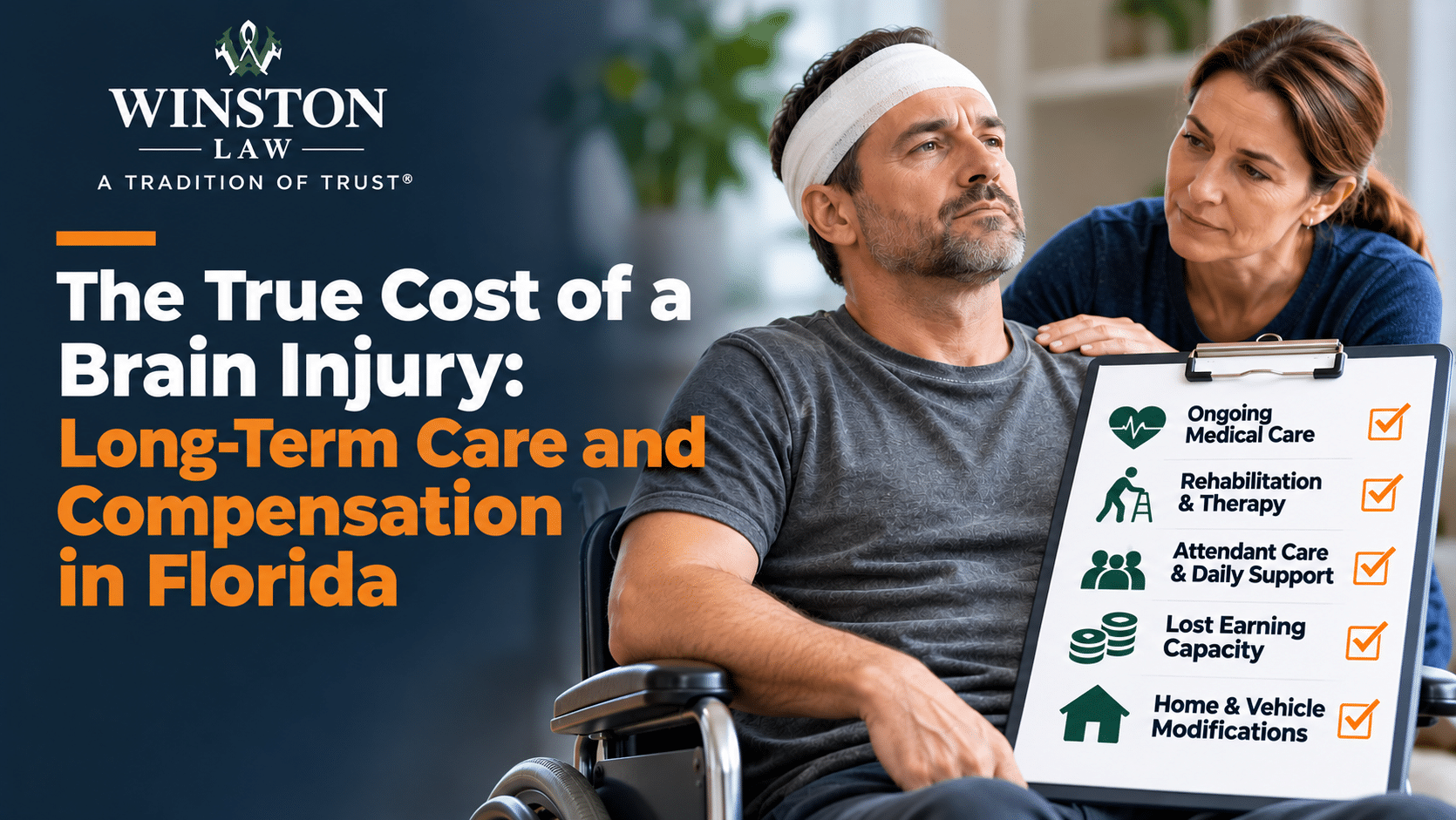
A serious brain injury can cost far more than the emergency-room bill or the first few months of rehabilitation. Therapy, specialist care, attendant assistance, lost earning capacity, medications, transportation, and changes to a home or vehicle may continue for years or even a lifetime.
For someone injured in a motor vehicle crash, Florida Personal Injury Protection (PIP) coverage provides only limited benefits compared with the potential cost of a serious traumatic brain injury. Depending on the circumstances, long-term financial recovery may involve a claim against a responsible party, available liability insurance, uninsured or underinsured motorist coverage, health insurance, public benefits, and other sources.
Brain injuries can result from car crashes, truck collisions, motorcycle accidents, falls, and many other incidents. A Fort Lauderdale traumatic brain injury lawyer can help identify the losses that need to be documented before a claim is resolved.
What Long-Term Care After a Brain Injury Can Involve
Traumatic brain injuries vary widely. Some people recover substantially after a concussion or other mild TBI, while others experience persistent cognitive, physical, behavioral, or emotional problems. Moderate and severe brain injuries can require extensive assistance and ongoing medical care.
Depending on the injury, long-term needs may include:
- Physical, occupational, speech, and cognitive therapy
- Neurological and neuropsychological evaluations
- Medication management
- Psychological or psychiatric treatment
- Assistance with bathing, dressing, eating, medications, and other daily activities
- Supervision for memory, judgment, behavioral, or safety problems
- Home health or attendant care
- Assistive technology
- Home modifications for accessibility and safety
- Vehicle modifications or alternative transportation
- Future hospitalizations, procedures, or specialist care
The challenge in an injury claim is not simply proving that these services could be useful. Future damages generally require evidence that the care is reasonably necessary and that the anticipated cost is connected to the person’s injury and prognosis.
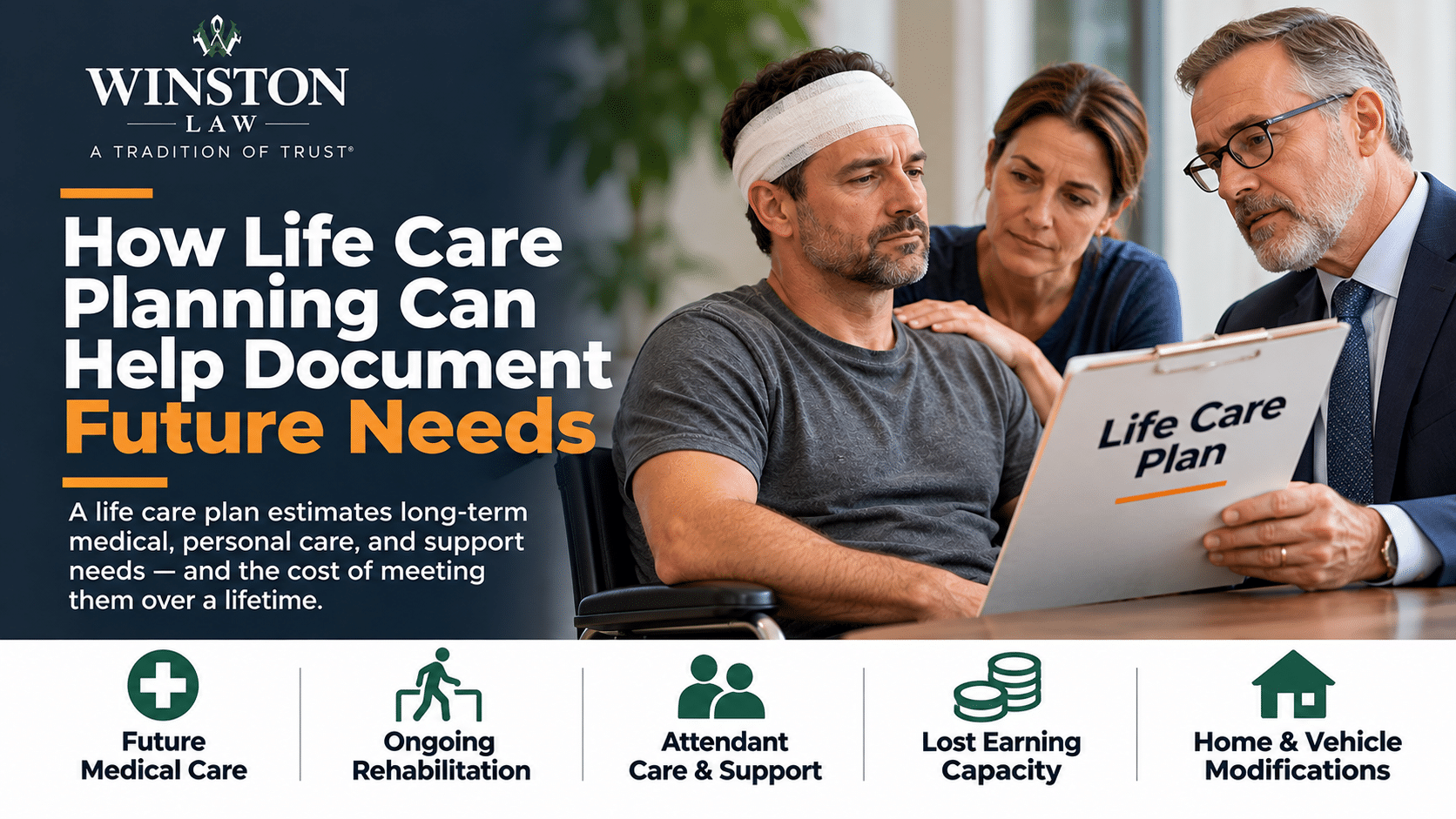
How Life Care Planning Can Help Document Future Needs
In a serious brain injury case, attorneys may work with physicians, rehabilitation professionals, life care planners, vocational experts, economists, and other specialists to evaluate the person’s future needs.
A life care plan can organize anticipated medical treatment, therapy, equipment, attendant care, transportation, and other services over the expected course of the person’s life. An economist may then help evaluate the financial impact of those future costs and income losses, including present value calculations when appropriate.
The goal is to replace speculation with evidence. A credible future-care analysis should be tied to the injured person’s actual medical condition, prognosis, functional limitations, insurance situation, and expected needs.
Lost Earning Capacity Can Be One of the Largest TBI Losses
A brain injury does not have to prevent someone from working entirely to cause a substantial financial loss.
A person may return to work but struggle with:
- Memory
- Attention and concentration
- Processing speed
- Executive functioning
- Fatigue
- Impulse control
- Communication
- Stress tolerance
Those limitations can make it difficult to return to the same occupation, maintain previous hours, qualify for promotions, or sustain the same earning level over a career.
Florida personal injury claims can include loss of earning capacity when supported by the evidence. Neuropsychological testing, employment history, wage records, vocational analysis, and economic testimony may help demonstrate how a brain injury has changed a person’s ability to earn in the future.
The Cost of a Brain Injury Can Extend to Family Caregivers
The financial impact of a serious TBI often extends beyond the injured person.
A spouse, parent, or adult child may begin providing transportation, supervision, medication assistance, personal care, household help, or other services that would otherwise require paid assistance. Family members may also reduce their own working hours or leave employment to provide care.
Depending on the circumstances and applicable law, the reasonable value of necessary services and other losses associated with the injury may become part of the damages analysis. A spouse may also have a separate derivative claim for loss of consortium when the legal requirements are met.
These losses should be documented rather than dismissed simply because the family is providing the care without sending an invoice.
Cognitive and Emotional Changes Can Be as Significant as Physical Injuries
Some of the most disruptive effects of a brain injury are difficult for other people to see.
A person who appears physically recovered may experience significant changes in memory, concentration, judgment, personality, mood, sleep, relationships, or independence. Depression, anxiety, irritability, emotional instability, and loss of enjoyment of life can affect both the injured person and the family.
Those effects can be relevant to non-economic damages when Florida law permits recovery.
For injuries arising from the use of a motor vehicle, Florida’s no-fault law restricts recovery for pain, suffering, mental anguish, and inconvenience unless the injury satisfies one of the thresholds in Florida Statute § 627.737. Those thresholds include a significant and permanent loss of an important bodily function, a permanent injury within a reasonable degree of medical probability, significant and permanent scarring or disfigurement, or death.
Whether a particular brain injury satisfies that threshold depends on the medical evidence and facts of the case.

How Florida PIP Coverage Works After a Brain Injury From a Crash
Florida PIP provides limited no-fault benefits after qualifying motor vehicle accidents.
Under Florida Statute § 627.736, required PIP coverage generally provides up to $10,000 in combined medical and disability benefits, subject to the statute’s requirements.
Medical benefits generally pay 80% of qualifying medically necessary expenses, while disability benefits generally cover 60% of qualifying lost gross income and loss of earning capacity, subject to the combined statutory limit.
Initial qualifying medical care generally must be obtained within 14 days after the motor vehicle accident. If an authorized provider does not determine that the injured person has an emergency medical condition, medical benefits are generally limited to $2,500.
For someone with a moderate or severe brain injury, those benefits can be exhausted quickly.
PIP should therefore not be confused with compensation for the full financial consequences of a catastrophic injury. A serious TBI claim may require investigating additional insurance and legally responsible parties.
Why Available Insurance Coverage Matters in a Serious Brain Injury Claim
A brain injury may create millions of dollars in future needs, but proving those damages and identifying a source from which they can actually be recovered are separate issues.
Potential sources can include:
- Bodily injury liability insurance
- Commercial automobile or business policies
- Uninsured or underinsured motorist coverage
- Umbrella or excess insurance
- Coverage belonging to additional responsible parties
- Health insurance
- Government or disability benefits
Florida does not universally require every ordinary driver to carry bodily injury liability insurance. That makes identifying all available insurance particularly important in catastrophic motor vehicle cases.
When appropriate, a serious brain injury investigation may also examine whether responsibility extends beyond one individual driver—for example, to an employer, vehicle owner, product manufacturer, property owner, or another party whose conduct contributed to the injury.
How Florida Law Treats Medical Expense Evidence
Florida’s 2023 tort reform legislation changed the evidence that may be used to prove past and future medical expenses in personal injury and wrongful death cases.
Florida Statute § 768.0427 now sets different evidentiary rules depending on whether medical expenses have already been paid, remain unpaid, involve health coverage, or relate to future treatment.
Past Medical Expenses That Have Already Been Paid
For past medical treatment or services that have been satisfied, evidence offered to prove the amount of damages is limited to the amount actually paid, regardless of the source of payment.
Unpaid Medical Expenses
For unpaid past charges, the statute permits different evidence depending on the injured person’s health coverage and how the treatment was obtained.
For example, when a claimant has private health coverage, evidence may include what the coverage is obligated to pay the provider plus the claimant’s share. For a claimant without health coverage, or one with Medicare or Medicaid, the statute permits evidence based on specified Medicare or Medicaid reimbursement rates, along with other evidence allowed by the statute.
Future Medical Expenses
The statute separately addresses future medical treatment.
When a claimant has or is eligible for qualifying health coverage other than Medicare or Medicaid, admissible evidence can include the amount for which future provider charges could be satisfied through that coverage plus the claimant’s share.
For someone without health coverage or with Medicare or Medicaid, the statute provides for evidence based on specified Medicare or Medicaid reimbursement rates. It also permits evidence of reasonable future amounts expected to be billed for medically necessary care.
For a serious brain injury claim, that makes it particularly important for a future-care analysis to reflect the injured person’s actual circumstances rather than relying only on inflated sticker prices or generic estimates.
Florida’s Brain and Spinal Cord Injury Program May Provide Additional Support
Florida also operates the Brain and Spinal Cord Injury Program through the Florida Department of Health.
Eligible Florida residents with qualifying traumatic brain or spinal cord injuries may receive case management and access to services such as rehabilitation, assistive technology, and home or vehicle modifications. Eligibility includes requirements relating to Florida residency, the nature of the injury, medical stability, and the potential for community reintegration.
The program is funded as a payer of last resort. Florida law also gives the program subrogation and lien rights when it pays for services and a third party is responsible for the injury.
That means BSCIP can be an important resource, but benefits received through the program also need to be considered when resolving a personal injury claim.
Why Settling a Brain Injury Claim Too Early Can Be Risky
The early months after a brain injury may not reveal the full prognosis.
A person may initially expect to return to work but later discover persistent problems with fatigue, memory, concentration, mood, or executive function. What begins as several weeks of therapy may develop into a need for continuing rehabilitation, supervision, medication, or vocational assistance.
Once a personal injury claim is settled and a release is signed, the injured person generally cannot return later and seek additional compensation because the long-term consequences turned out to be more serious than expected.
For that reason, serious brain injury claims should be evaluated with attention to future needs rather than only the bills that have accumulated so far.
Pre-Existing Conditions Do Not Necessarily End a Brain Injury Claim
Insurance companies may examine a person’s prior medical history when evaluating whether an accident caused particular symptoms or limitations.
A prior concussion, neurological condition, psychiatric history, or other medical issue can therefore become an important part of the evidence.
The existence of a pre-existing condition does not automatically prevent recovery. The issue may instead be whether the accident caused a new injury or aggravated an existing condition.
Comparing prior records with post-accident imaging, neurological examinations, neuropsychological testing, witness observations, and changes in work or daily functioning can help establish what changed after the incident.
Florida Deadlines and Comparative Fault Can Affect a Brain Injury Claim
Florida generally provides a two-year limitations period for negligence actions under Florida Statute § 95.11. The exact deadline can vary depending on the claim type, defendant, accrual rules, and other circumstances.
Waiting can also create evidentiary problems. Witnesses become harder to locate, surveillance footage can disappear, vehicles or property conditions may change, and memories fade.
Florida’s comparative fault law can also affect recovery. Under Florida Statute § 768.81, damages in covered negligence actions are reduced according to the claimant’s percentage of fault, and a claimant found more than 50% responsible for their own harm generally cannot recover damages.
Building a Brain Injury Claim Around the Person’s Future
The true value of a serious brain injury claim is rarely found by simply adding the medical bills already received.
A thorough evaluation may need to consider:
- What medical treatment is likely to be needed in the future
- Whether the person will need supervision or attendant care
- How the injury affects employment and future earning capacity
- Whether the home or vehicle must be modified
- What insurance and public benefits are available
- How cognitive and behavioral changes affect independence and relationships
- Whether family members are providing necessary unpaid care
- How long those needs are expected to continue
That evidence can help distinguish the immediate cost of the injury from its true long-term financial impact.
Talk With a Fort Lauderdale Brain Injury Lawyer About Long-Term Care Needs
Winston Law Firm has represented injured Floridians since 1989. A serious traumatic brain injury can affect medical care, employment, independence, family relationships, and financial security for years after the accident itself.
If you or a family member suffered a TBI because of another party’s negligence, a Fort Lauderdale traumatic brain injury lawyer at Winston Law Firm can review the medical evidence, investigate available insurance coverage, and help document the future losses that may need to be considered in the claim.
You can also review our case results or contact Winston Law Firm for a free consultation at (954) 475-9666.
