




A fully loaded tractor-trailer can weigh many times more than a passenger vehicle. When a commercial truck crashes into traffic on I-95 through Broward County, the people in smaller vehicles often suffer the most serious consequences. These crashes may be blamed on a single driver at first, but many truck accident claims reveal a deeper problem: unsafe decisions made by the trucking company before the truck ever reached Fort Lauderdale.
Trucking company negligence can involve careless hiring, poor supervision, unrealistic delivery schedules, inadequate training, ignored maintenance problems, or pressure that pushes drivers to stay on the road when they should not. When a carrier cuts corners on safety, injured people and their families are left to deal with the physical, financial, and emotional damage.
A Broward County truck accident lawyer at Winston Law can investigate those company-level decisions, identify the evidence needed to prove what happened, and work to hold the right parties accountable.
How Trucking Company Negligence Causes I-95 Crashes
Trucking company negligence often starts long before the crash itself. While a driver’s actions matter, the company that hired, trained, supervised, dispatched, and maintained the truck may also share responsibility.
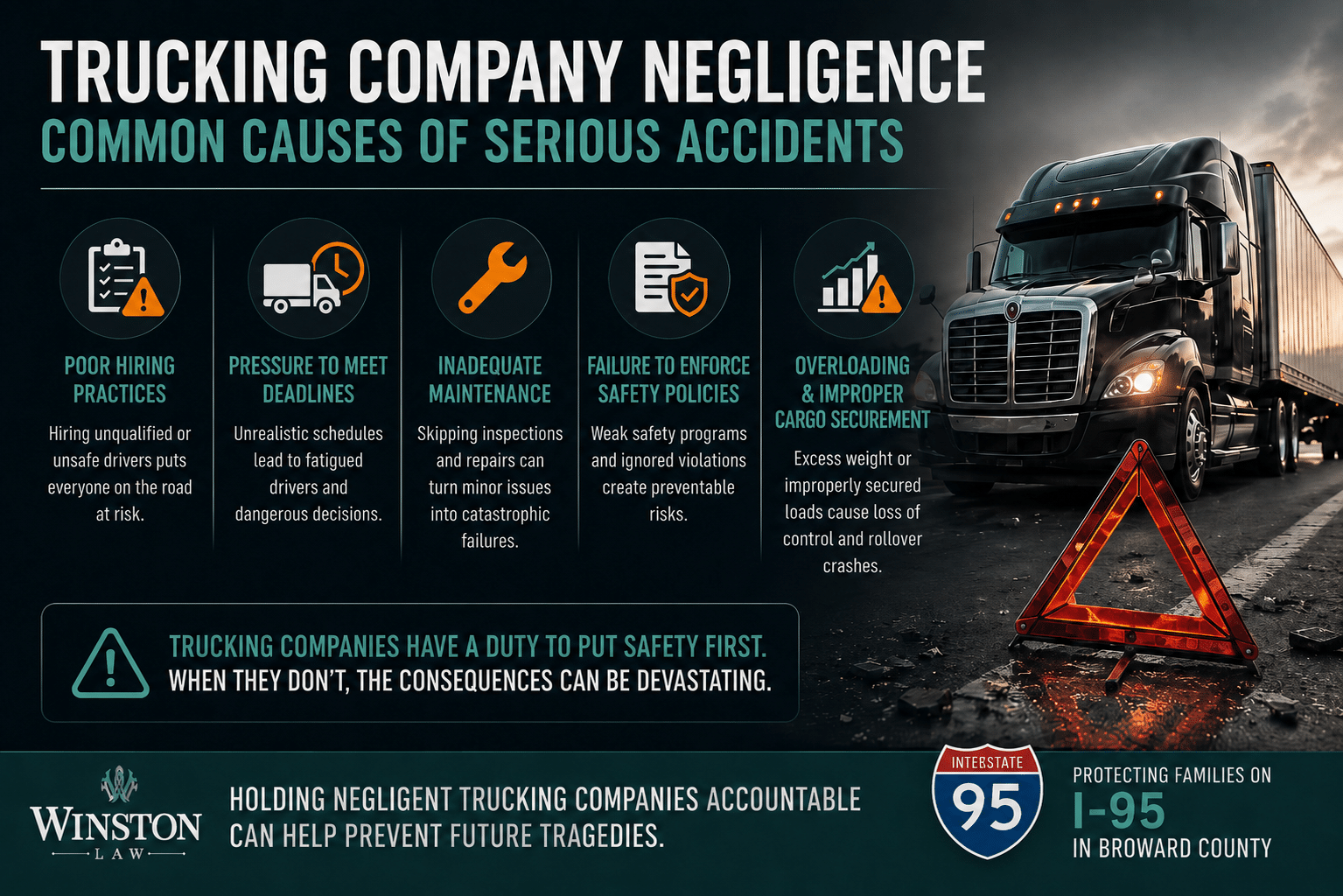
Common examples of trucking company negligence include:
- Negligent hiring and retention: A carrier may be responsible if it hires or keeps a driver with a poor safety history, prior violations, substance abuse concerns, or a record of dangerous driving.
- Negligent entrustment: A trucking company may create danger when it gives the keys to someone who is not qualified, properly licensed, medically fit, or adequately trained to operate a commercial vehicle.
- Unrealistic delivery schedules: Carriers may pressure drivers to meet deadlines that encourage speeding, skipped rest breaks, or fatigued driving.
- Inadequate training: Truck drivers need proper training on vehicle handling, braking distance, cargo safety, defensive driving, company procedures, and federal safety rules.
- Poor supervision: A company may ignore warning signs, such as repeated violations, complaints of unsafe driving, failed inspections, or hours-of-service violations.
- Improper maintenance practices: A carrier may contribute to a crash by allowing trucks with worn brakes, bad tires, lighting problems, steering issues, or other mechanical defects to remain in service.
Each of these choices can raise the risk of a serious collision. They can also point to liability beyond the truck driver alone.
Federal Rules That Apply to Interstate Trucking
Interstate trucking companies must follow Federal Motor Carrier Safety Regulations enforced by the Federal Motor Carrier Safety Administration. These rules exist because large commercial vehicles are harder to stop, harder to maneuver, and more dangerous when operated unsafely around passenger vehicles.
The federal hours-of-service limits restrict how long commercial drivers may drive and remain on duty before they are required to rest. These rules are important because driver fatigue can slow reaction time, reduce judgment, and increase the risk of a serious crash.
Federal rules also address driver qualification standards, medical requirements, licensing, vehicle inspections, repairs, and maintenance. Inadequate maintenance, such as worn brakes or bald tires, can turn a routine trip into a catastrophic wreck. Loading practices matter as well because overweight or shifting cargo can make a trailer difficult or impossible to control.
After a serious truck crash, logs and maintenance records may become some of the most important evidence in the case. These records can help show whether the driver was operating too long, whether the truck was properly inspected, whether repairs were ignored, or whether the company failed to follow safety requirements.
Timing matters. Some records may be kept only for a limited period, and trucking companies may act quickly after a crash to protect their own interests. A prompt preservation demand can help prevent key evidence from being lost, destroyed, or overwritten.
Who Can Be Held Liable in a Truck Accident?
Several parties may be liable after a truck crash. That is one reason commercial truck accident cases are often more complicated than ordinary car accident claims. Depending on the facts, responsibility may extend to:
- The truck driver who caused the crash
- The motor carrier that employed, dispatched, or supervised the driver
- A broker that arranged the load
- A maintenance contractor that serviced the truck
- The shipper or loading company responsible for cargo issues
- A parts manufacturer if defective equipment contributed to the crash
A carrier may not be able to avoid responsibility simply by pointing to an independent contractor arrangement if the company’s own dispatching, training, supervision, maintenance, or safety decisions contributed to the crash.
A Fort Lauderdale truck accident attorney can work to identify each responsible party and the insurance coverage behind them. Pulling corporate records, driver logs, inspection files, maintenance records, dispatch information, and federal safety data early can shape the outcome of a truck accident claim.
What Evidence Can Prove Trucking Company Negligence?
Truck accident cases often depend on evidence that is not immediately available to the injured person. The trucking company, driver, maintenance contractor, broker, or shipper may control many of the records needed to prove what happened.
Important evidence may include:
- Driver qualification files
- Hours-of-service logs
- Electronic logging device data
- Dispatch records
- Delivery schedules
- Maintenance and repair records
- Inspection reports
- Post-crash drug or alcohol testing records
- Cargo loading records
- Black box or event data recorder information
- Company safety policies and training materials
- Prior violations or crash history
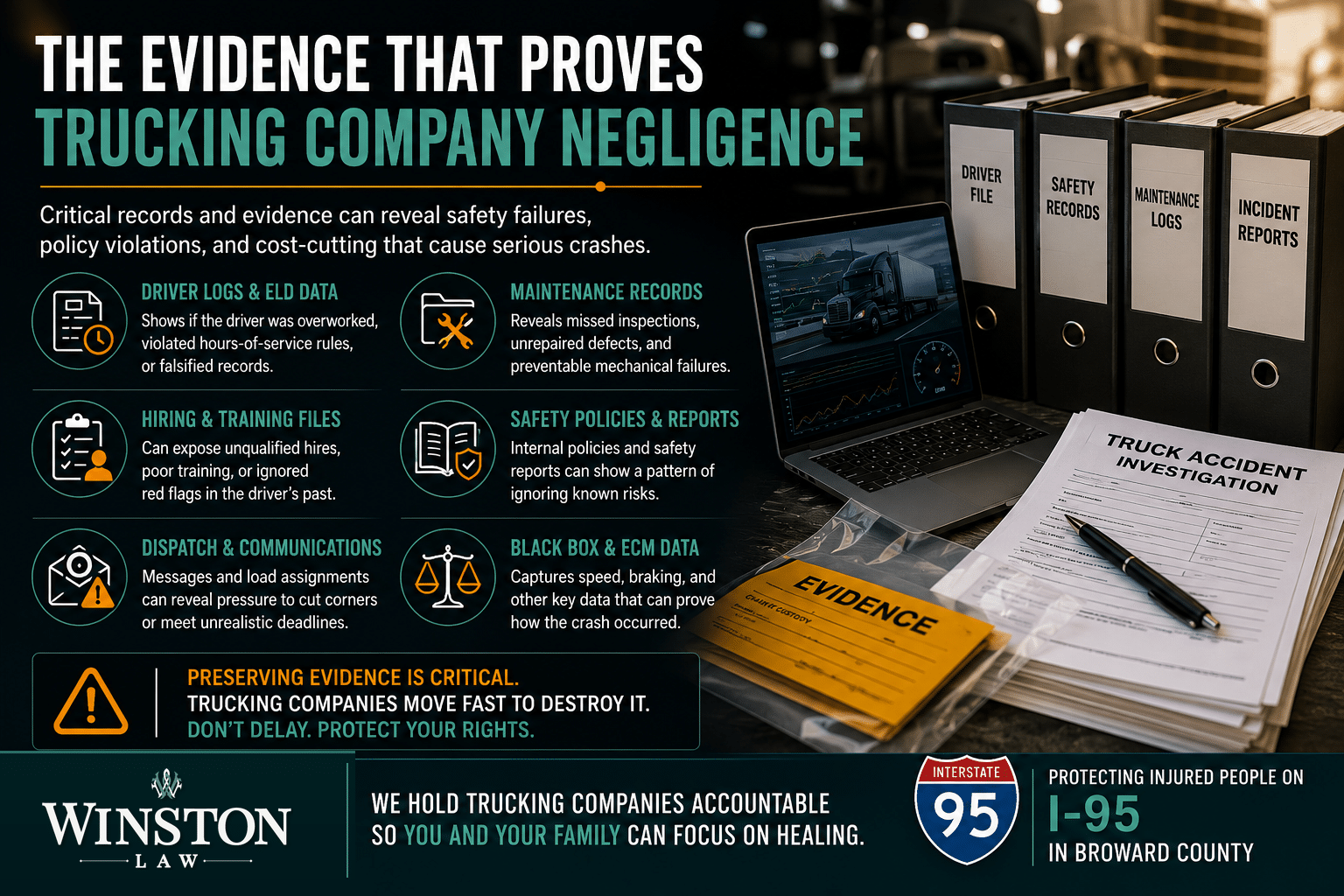
Strong cases often depend on preserving this evidence before it disappears. Video evidence from nearby cameras can also help show what happened before recordings are erased. That may include traffic cameras, business security cameras, dash cameras, cameras from nearby properties, or footage from vehicles involved in the crash.
What a Broward County Truck Accident Claim Can Recover
The compensation in a truck accident claim can extend far beyond the first hospital bill. A serious I-95 crash can affect a person’s health, ability to work, daily life, family responsibilities, and long-term financial security.
A full claim may include compensation for:
- Emergency medical care
- Hospitalization
- Surgery
- Future medical treatment
- Rehabilitation and therapy
- Lost income
- Reduced earning capacity
- Pain and suffering
- Permanent injuries or disability
- Loss of enjoyment of life
- Wrongful death damages when a family loses a loved one
Putting a real number on future care is often one of the most important parts of a truck accident case. Injured people may need ongoing treatment, assistive devices, home modifications, reduced work duties, or long-term medical support. The claim should account for the full impact of the crash, not only the immediate expenses.
Florida’s Truck Accident Filing Deadline and Fault Rules
Florida’s deadline to file a negligence claim is generally two years. Missing the filing deadline can prevent an injured person from recovering compensation, even when the trucking company or another party was clearly responsible.
Florida also applies a modified comparative negligence rule. In many negligence cases, a person found more than 50 percent at fault cannot recover damages, and any award may be reduced by that person’s share of fault.
Because trucking companies and their insurers often try to shift blame, both the deadline and the fault analysis matter. A trucking company may argue that the injured driver stopped too suddenly, changed lanes improperly, failed to avoid the crash, or contributed in some other way. Evidence such as driver logs, electronic data, maintenance records, witness statements, police reports, and video footage can help respond to those arguments.
Hold the Carrier Accountable With a Broward County Truck Accident Lawyer
A serious crash on I-95 can upend your health, your finances, and your sense of security. You do not have to take on the trucking company, its insurance carriers, and its investigators by yourself.
Winston Law can investigate the carrier, request driver logs and maintenance records, identify all potentially responsible parties, and pursue the compensation available under Florida law. The sooner the investigation begins, the better the chance of preserving evidence that may prove what the company knew, what it ignored, and how its decisions contributed to the crash.
If you or a loved one was injured in a truck accident on I-95 in Broward County, call Winston Law or contact us online to set up a free consultation.
Frequently Asked Questions About Trucking Company Negligence in Broward County
Can a trucking company be liable for an I-95 crash in Broward County?
Yes. A trucking company may be liable if its negligence contributed to the crash. This may include negligent hiring, poor training, unsafe scheduling, lack of supervision, ignored maintenance problems, or pressure that encouraged the driver to violate safety rules.
What records can help prove trucking company negligence?
Driver logs, electronic logging data, maintenance records, inspection reports, dispatch records, delivery schedules, driver qualification files, cargo records, and company safety policies may help prove trucking company negligence. These records can show whether the carrier followed safety rules or cut corners.
Can a trucking company be responsible if the driver was an independent contractor?
Possibly. A trucking company may still share responsibility if its own conduct contributed to the crash, even if the driver was labeled an independent contractor. Dispatch decisions, supervision, training, maintenance, and company safety practices may all matter.
Who can be held liable after a Florida truck accident?
Liability may extend to the truck driver, motor carrier, broker, maintenance contractor, shipper, cargo loader, or parts manufacturer, depending on what caused the crash. Truck accident cases often require a detailed investigation to identify every responsible party.
How long do I have to file a truck accident claim in Florida?
Florida negligence claims are generally subject to a two-year filing deadline. However, the facts of the case, the parties involved, and other legal issues may affect the timeline. Injured people should speak with a lawyer as soon as possible after a serious truck crash.